
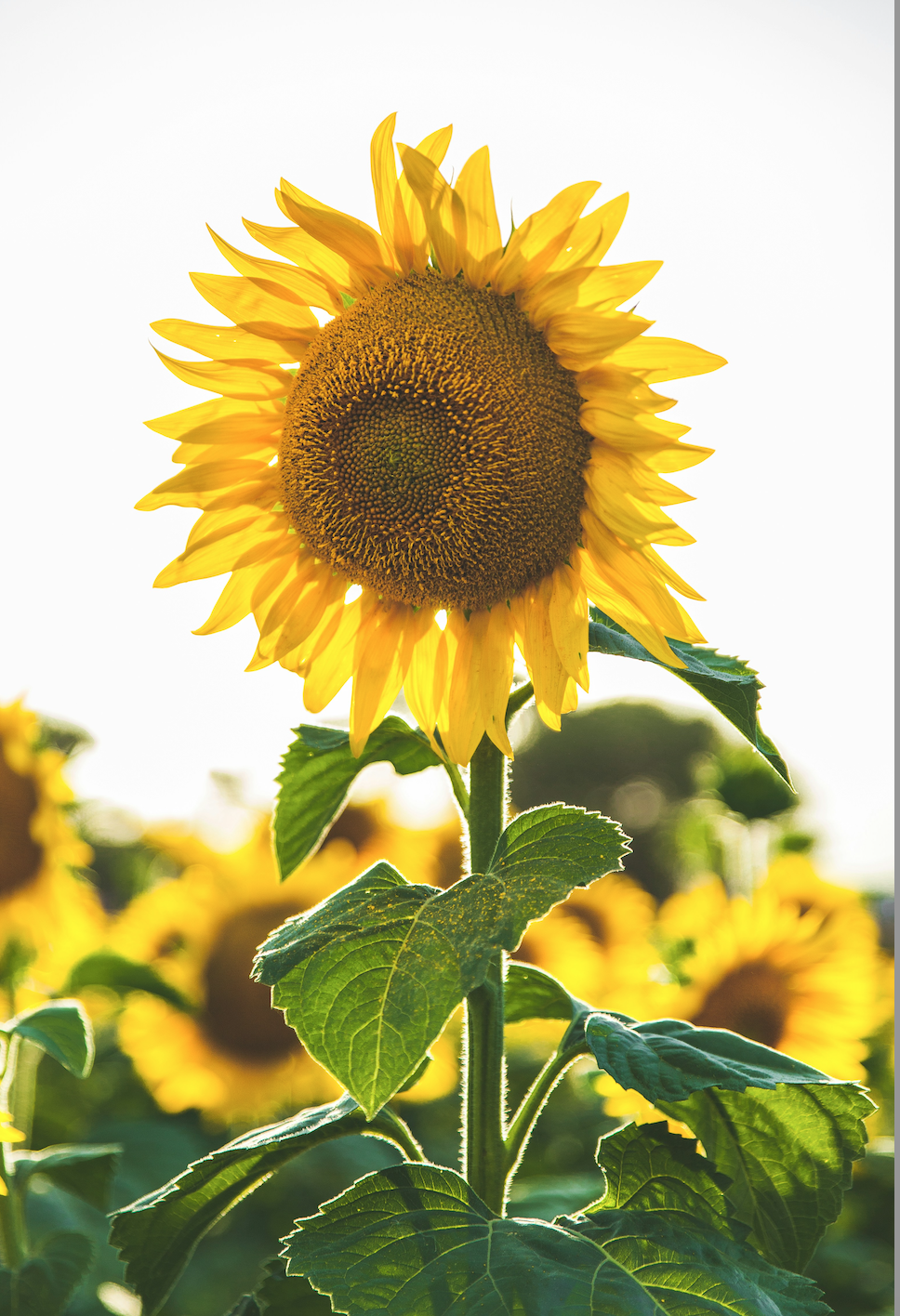
Sunflower, Helianthus annus
It can be said that the Asterales flowers function as a co-operative. The flowers are among the plant kingdoms most advanced botanical structures, and being at the end of the column represents our most developed state to date and seems to parallel our time.
The sunflower has the biggest flower of all the Asterales, and is so named because the flower is in constant motion, turning it’s face in the direction of the sun. The plant is sensitive to dehydration, when it loses too much water, the transportation vessels lose their flexibility, the leaves droop and are unable to return to their original structure and they then wilt and die.
The sunflower is a construction of small tubular florets tightly packed on the ‘head’. We all are familiar with sunflower seeds, we roast them and eat them. The oil of the sunflower seed is rich in linoleic acid. It is the central flowers that are the fertile seeds, while the flowers on the periphery do not reproduce but serve as colourful advertisers to pollinators, those outward facing petals. The entire thing creates an illusion of an single, ordinary flower.
The Asterales family of plants (Compositales) is the youngest group among the plants, found at the 6th column on the 9th row of Yakir’s table of plants. Most are herbs or shrubs and all of the Asterales have the same general arrangement of the flowers that to the onlooker appear as one flower. Asterales are found all over the world, and survive every climate, and wherever they are, many of them serve as local ‘arnica’ for injuries, bruises and bleeding.
Individualism vs Collectivism
It can be said that the Asterales flowers function as a co-operative. The flowers are among the plant kingdoms most advanced botanical structures, and being at the end of the column represents our most developed state to date and seems to parallel our time. We arrive battered and beaten from our rigorous journey through the stages of the table. Hence the use of many as local plants used for injury, bruising and bleeding.
The Asterales family contains some of our most favourite healing remedies: arnica Montana, bells perennis, calendula officinalis, carduus marianus, echinacea angustifolia, eupatorium perforliatum, arcticum lapps (burdock), senecio aureus (golden ragwort), solidago virgaurea (golden rod) tanacetum vulgar (tansy), taraxacum official (dandelion) , tussilago farfara (coltsfoot) and Helianthus annus (sunflower).
This is the last most ego centric period. The struggle of the column is how to be an individual and still be part of the community. How to maintain my integrity, my freedom, my choices, my independance and also belong to community. What is me and mine, and what is you and yours and how to negotiate what is ours. The balance of self autonomy and self regulation and living in a community or group. How to keep a culture in tact via language, stories, music while the community is flooded with others, who are not assimilated.
The Remedy
The remedy itself like arnica, has an affinity for injuries, bruises and especially for the healing of bleeding and congestion especially in the head.
Sunflower was used in Russia as a remedy for malaria (cases of intermittent fever) hence its use in returning fevers and malarial fever (Burnett). The remedy is a picture of someone who has spent too long in the sun: heat, congestion of the face, skin is dry and hot. Yakir.
It shares column 6 themes of allergy: chronically blocked nose, redness in the eyes, burning and heat in the nose. Allergy is a characteristic symptoms of the Asterales, as if fighting with the world.
The flower essence description of Helianthus fits with the themes of the column and rows: pride, a strong ego that needs reassurance. Feels he is insufficiently valued. Tries to be the centre of society, to be well accepted, antic playing. Honor: “gives much value to their dignity and integrity” Mangialavori.
Always seeking the sun, or to be in the sun. “Distorted sense of Self; inflation or self-effacement, low self-esteem alternating with arrogance; finds it difficult to speak, lacks confidence but hides it. Sholten.
Mangialavori connects the dignity of the remedy to his idea of ‘touch me not’. All of the asterales are sensitive to their honor being touched, but the sunflower, the element of arrogance/lack of confidence is very much dependent on the way they are touched; she needs the touch of the group to be in a certain way, the feeling of ‘don’t touch me, unless you yourself also come from the sun’ or ‘if you are significant or important’. Yakir.

Bee Keeping as an Existential Experience
I put on a full (and hot) sealed outfit which keeps me safe. We pull up on the ATV. The dogs are barking and excitedly circling us. I am given the job of ‘smoker’. Smoking the bees keeps them docile while Liz does the job of pulling out each panel to look for the queen. I take my job seriously. For me a good bee is a docile bee.
This summer I had the pleasure of attending an annual gathering of my Naturopathic colleagues at my colleague and friend Dr. Elizabeth Storjohann ND (https://www.woodsideclinic.com/) on her property in southern Ontario.
Our group gathers annually to share stories and the latest, and also, to eat. The food is fabulous, Liz is an amazing cook. We invite speakers and this year there was a herbal identification walk on the property with virididas herbs.
Not only is Liz an excellent forager and cook, she has recently started a bee hive on the property and I was invited to come out to help her look for the queen (who is apparently lost?).
I put on a full (and hot) sealed outfit which keeps me safe. We pull up on her ATV. The dogs are barking and excitedly circling us. I am given the job of ‘smoker’. Smoking the bees keeps them docile while Liz does the job of pulling out each panel to look for the queen. I take my job seriously. For me a good bee is a docile bee.
To say the experience was unnerving is an understatement. There were thousands of bees. Liz lets me know that the bees can sense my fear and nervousness and that I can take a breath and settle. She reminds me I am fully protected in my suit and I am compleatly safe. I take a breath and let myself move into a calm centred place. To be with the massive activity and loud hum, from a centred place. It was empowering
The intensity of the low loud hum was other worldly. I feel the physical vibration in my body and the hum transports me and connects me deeply to nature.
I am appreciating the value of these busy creatures. Pollinators are critical to the survival of North America’s native plants, wildlife and people and apparently both domesticated and native honey bees are in decline.
As I write this, this reminds me of how similar this is to the state of being with the world these days. Loud buzzing and activity, with the potential for danger, can easily put me off balance. Taking steps to create safety, and then reminding myself that I am safe, to take a breath and move myself into a more centred calm place, allows me to be with, in a more settled neutral way.

Introduction to Topicals: Poultices and Plasters
Pain fatigues our body. Ongoing pain over a period of time, wears us down and wears out the adrenal glands. When this happens, compounding health problems result. If you are not yet familiar with this aspect of healing and how it is integral to your health, get curious. In this article, learn more about topical applications and how they can help in pain management.
Why should I treat my pain?
Pain is exhausting. Ongoing pain over a period of time, wears us down and wears out the adrenal glands. When this happens, compounding health problems result. If you are not yet familiar with the adrenal gland aspect of healing and how it is integral to your health, get curious and learn more. In this article, learn more about topical applications and how they can help in pain management.
Introduction to Topicals: Poultices and Plasters
Gel, clay, liquid…wrapped, unwrapped….messy, easy application…there are an unlimited number of options we have for topical application of natural products that can help reduce inflammation. You are going to like some things better than others, and at the end of the day, it’s your choice.
What’s the difference
A poultice is a wet clay that helps draw out inflammation. A wet clay/product also has a cooling effect when first applied. The idea of a poultice has been around for centuries and sometimes contains minerals or salts that provide additional relief. You can apply a poultice anywhere on the body. However it can be quite messy especially if not wrapped. It is a great option as an adjunct to healing of injuries.
A liniment is often in a gel or liquid form. Wrapping over top of these medicinal treatments will help enhance or prolong the effects. However they can cause skin irritation for some sensitive skin. Always test before you apply and leave it unwrapped until you are sure it works for you.
You can find homeopathic preparations which are designed to be used topically. Things like Arnicare or topical preparations for burns, however please keep in mind that a topical preparation of a complex homeopathic is no substitute for taking the individual remedy orally. The homeopathic remedy will always out perform any topical complex product. Saying that, it is possible to put your home homeopathic arnica dose in some pure water, and apply this topically.
A homeopathic remedy will always out perform any topical homeopathic complex product
Traditional Chinese Medicine Plasters
Traditional Chinese Medicine (TCM) is untouched in its ability to help with healing of musculoskeletal injuries and pain. In 20 words or less, here’s TCM theory: Qi and blood flows freely in our body. When Qi gets stuck or is not moving well, this creates pain. Both TCM and homeopathy work the same way by stimulating the innate self healing of the body.
I will talk here about one aspect of healing with TCM and that is treating damage to soft tissue (ligaments, tendons etc) as a result of sprain, strain or bruising. This is different from bone fractures, dislocations, cuts and lacerations.
In TCM there are 3 stages of treating injury to soft tissue damage by external application (plasters)
Stage 1: the period where swelling, pain and redness are still present, this usually is the first 4-7 days but can be 2-3 days in light cases.
Stage 2: The second stage is the period during which swelling and pain (with aching and stiffness) still exist, but in a less severe form, lasting up to 3 weeks.
Stage 3: The third stage is where most of the symptoms have resolved, and the only symptoms left are persistent aching and stiffness. Plasters and acupuncture at this stage are used for other symptoms such as the chronic pain of arthritis, and long term injury pain.
Each stage has a different herbal plaster formula and purpose, all of which ease pain and discomfort and speed healing. For nagging ongoing injury or pain, the treatment in TCM is to gently move the Qi and blood, using topical application of plasters, acupuncture, and moxibustion.
There are many examples of common foods and plants used in folk medicine.
Clay
Infections, boils, tumours, – apply ¼ to ½ inch thick. Mix with hot water, herb tincture, or tea.
Cabbage Leaf
Remove rib and use rolling pin to flatten a few leaves to cover area. This removes poisons and pus. Change the poultice when it gets hot. It is an excellent poultice for cystic breasts.
Carrot Pulp
For sores, chapped skin and cracked nipples. You may use pulp from your juicer.
Figs
Boil in water for 3 minutes. Cut open and place over infected sore to bring to a head.
Garlic
Press garlic into a mush. Mix with a small amount of water and flour. Good for pustulant sores and infections.
Potato
Peal and grate raw potato. This will remove stingers and pus. Good also for styes and some eye infections.
Plantain
Chew or bruise raw leaves and place directly on bee stings or open wounds.
Bread and Milk
Soak a piece of baguette in milk and apply to splinters.
Seaweed
Fresh or rehydrated seaweed is wrapped around arthritic joints.
Cucumbers
Fresh slices are placed over closed eyes to soothe and hydrate.
Used teabags
After brewing black tea place tea bags over irritated eyes.
Honey
Pour honey into open wound and cover with gauze and tape.
_____________________________________________________________________________________________
Please note that Dr. Doan accepts no liability whatsoever for any decisions that I may make for my health based on reading this information. The information is meant to educate only and does not constitute medical or naturopathic advice and makes no claim or promise that any product or service that may cure any condition or ailment. Always consult your doctor or naturopathic physician when it comes to your personal health, or before you start any treatment.
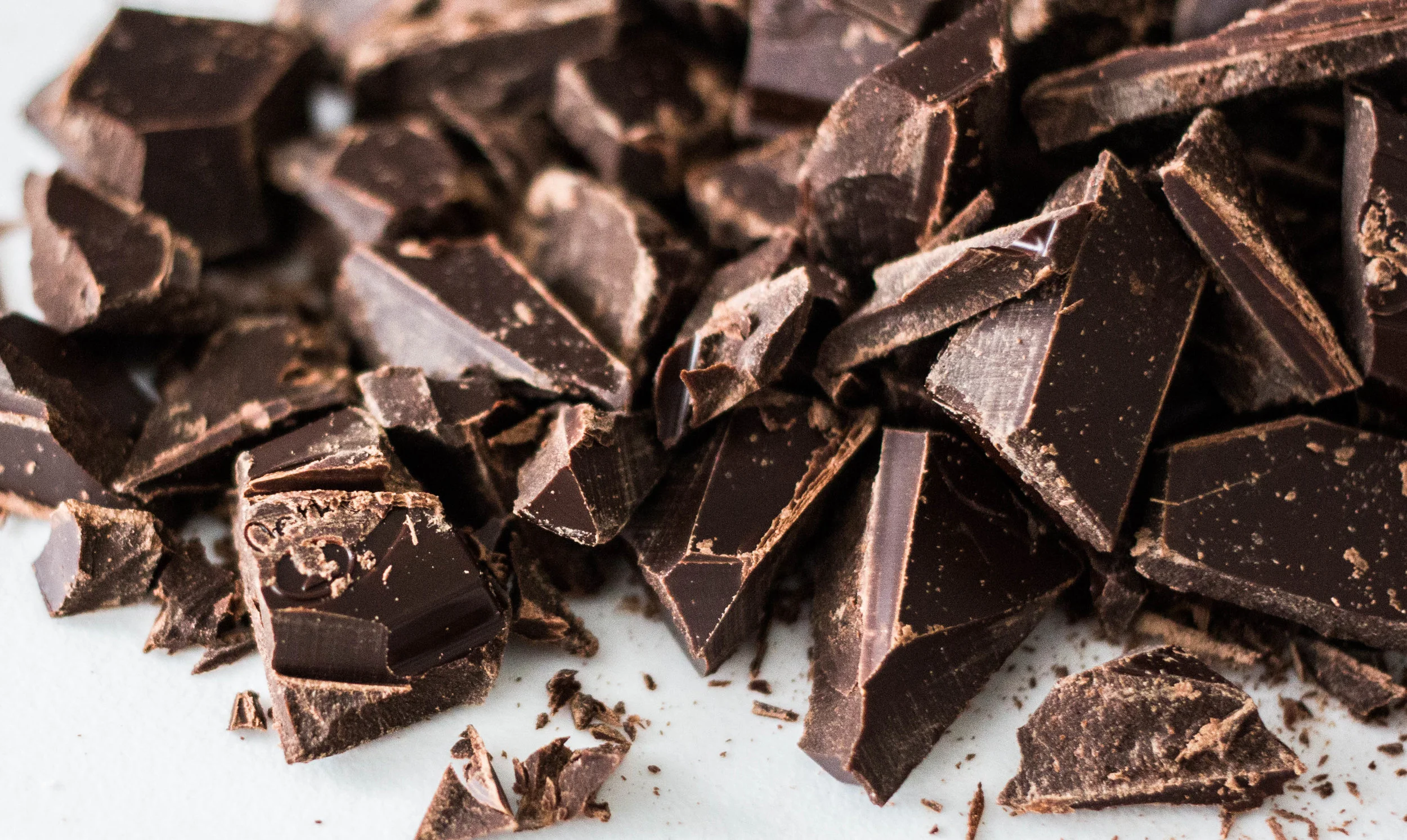
Here Are 7 Chocolate Recipes You Don't Have to Feel Guilty About
Christmas is approaching quickly and there’s a lot of sugar around. If you are a chocolate lover like I am, let's not miss out on all the fun.
If you are managing your blood sugar like I am, it’s nice to know that 70% dark chocolate has a low glycaemic index of 22. I am sharing my favourite recipe ideas that I hope you find useful over the holidays…(click on image above to read full article).
Christmas is approaching quickly and there’s a lot of sugar around. If you are a chocolate lover like I am, let's not miss out on all the fun.
If you are managing your blood sugar like I am, it’s nice to know that 70% dark chocolate has a low glycaemic index of 22. Hypoglycaemic guidelines state we stay below a glycaemic index of 50, so this works, right? Dark chocolate is a guilt free treat.
These are some of my favourite chocolate recipes that I make at home. I hope you like them too.
1. Chocolate Pudding
2 cups of coconut milk
1/2 cup chia seeds
2-3 tbs cocoa powder (or to taste) optional
1 tsp vanilla (or to taste)
1 tbs sweetener of choice (may use maple syrup, honey) optional
Put all in a blender and blend until smooth. Will thicken in about 10 minutes in the fridge.
There are endless flavour variations. You can omit the cocoa powder and vanilla and add a cup of strawberries or other fruit for a version, or add cinnamon and nutmeg for a Chia Chia Pudding. Enjoy!
2. Dark Chocolate Almond Bark (makes 1/75 lbs or 875 grams)
1.5 lb dark chocolate, finely chopped
1 cup unblanched whole almonds (toasted optional)
In bottom of double boiler, bring water to a simmer. Remove from heat. Add chocolate to top of double boiler and stir frequently until melted. Do not overheat. Stir in almonds.
Spread evenly onto an 11" by 15" pan, lined with waxed paper. Refrigerate 1h or until firm. Break into pieces. Can be layered between wax paper and stored in an airtight container and refrigerated for up to 3 weeks.
3. Chocolate Macaroons (makes approx 4 dozen cookies)
1/3 cup unsweetened cocoa powder
3 egg whites (organic or free range)
2 cups unsweetened shredded coconut
pinch salt
1 tsp vanilla
Preheat oven to 325 degrees F
Stir or sift through cocoa (to remove lumps) until smooth.
In a separate bowl, beat egg whites with salt until stiff peaks form. On your hand mixer low speed, gradually beat in cocoa, 1 tbsp at a time. Fold in coconut and vanilla.
Drop teaspoonfuls (5ml) of dough, 1 inch apart onto greased baking sheets. Bake at 325 degrees F for 15-17 minutes or until outsides are dry, but insides are still soft. With spatula, immediately transfer cookies to racks; let cool.
4. Chocolate Covered Dates. Makes a lot.
This is a delight that I discovered when travelling through Dubai, where dates are a specialty.
28 oz (794g) organic pitted dates
Organic almonds, count one per date (you get to count)
1 lb good quality dark chocolate (approximately)
Stuff each date with an almond. Place to one side.
In bottom of double boiler, bring water to a simmer. Remove from heat. Add chocolate pieces to top of double boiler and stir frequently until melted. Do not overheat.
Drop dates into melted chocolate, make sure they are covered. Remove date and place
on 11 by 15 pan, lined with waxed paper. When all dates are covered, refrigerate for 1h or until firm. Store in an airtight container in the fridge. Enjoy!
5. Chocolate Zucchini Cupcakes
with allspice and cinnamon, this recipe is from the Rebar Cookbook. Yields 9 large cupcakes.
1 cup brown sugar
1/4 cup melted butter
3/4 c olive oil
3 eggs
1 tsp vanilla
1/2c buttermilk
2 cups grated zucchini
1 cup dark chocolate chips
2 cups unbleached flour
1 cup cocoa sifted
1/2 tsp salt
2 tsp baking soda
1 tsp allspice
1.5 tsp cinnamon
1. Pre-heat oven to 350 F. Lightly grease large muffin pans and line w muffin cups.
2. In a medium bowl mix together the sugar, butter and oil. Beat in eggs, one at a time until well incorporated. Stir in vanilla, buttermilk, zucchini and chocolate chips.
3. In a separate bowl mix together all of the dry ingredients. Add the liquid ingredients and mix until well combined. Spoon batter into large muffin pans. Bake in the centre of the oven for 35 minutes or until a toothpick comes out clean. Cool on a wire rack.
This recipe can be used to make cake and is especially great for children's birthday cakes.
6. Chocolate Black Bean cake
15oz cooked black beans
5 eggs
1 tbs pure vanilla
1/2 tsp salt
6 tbs coconut oil
1/2c honey
6 tbs cocoa powder
1 tsp baking powder
1/2 tsp baking soda
1 cup chocolate chips
Place the black beans in a large bowl and use a hand blender to grind to a smooth consistency. Add the eggs one at a time, beating in smoothly. Add the other wet ingredients.
In a separate bowl, mix the dry ingredients together and smooth out any lumps.
Blend the dry ingredients into the wet, and mix together.
Grease or line a baking pan. Bake at 350 for 30-40 minutes or when a toothpick comes out clean.
7. Hot Chocolate
1.5 tbs pure cocoa powder
Heavy cream or whipped cream
1 tbs maple syrup
Pure chocolate has a low glycaemic index, and so does whipped cream…here is a hot chocolate recipe that you don’t have to feel guilty about.
Place all ingredients in your favourite mug…add hot water and enjoy.
8. Bonus Recipe…Pumpkin Quinoa Muffins
Yields 15 large muffins
Not chocolate but very yummy and handy for the holidays or anytime. This recipe also comes from the Rebar cookbook, and I have modified it from Pumpkin millet muffins, to Pumpkin Quinoa Muffins.
2 eggs, beaten
1/2c veggie oil
1c buttermilk or full cream
1/2c brown sugar/maple syrup
1/2 tsp vanilla
1.5 c pumpkin puree
1/2c rolled oats
1/2c cooked quinoa
1/4c pumpkin seeds
1.75c almond flour (this is what I use in this recipe, substitute what you like)
2 tsp baking powder
1.5 tsp baking soda
1/2 tsp salt
1/2 tsp cinnamon
1/2 tsp ground ginger
1/4 tsp freshly ground nutmeg
1. Preheat oven to 350F, Grease or line muffin tin. Combine eggs, oil, buttermilk, sugar, vanilla and pumpkin in a large bowl and mix together, making sure there are no lumps of brown sugar. Stir in the oats. Add in pumpkin seeds and quinoa and mix.
2. In a separate bowl, sift the dry ingredients together. Add the dry mix to the wet mix and gently stir to combine. Do not overmix, or the muffins will be dry and tough.
3. Fill muffin cups generously with batter. Bake for 25 minutes or until an inserted toothpick comes out clean.
9. Bonus #2 Since You Asked Chocolate Oatmeal Ginger Cookies
Ingredients:
1 cup cold unsalted butter, cut into small cubes
1.25c brown sugar
1 tsp vanilla
2 free range eggs
1 tsp salt
1 tsp baking soda
3 tbs ground ginger
1.25 cup almond flour
3 cups quick cook oats
1 cup chocolate chips
1 cup chopped pecans
1. Blend cold butter cubes into sugar in a large mixing bowl to form a uniform blend.
2. Add eggs, vanilla, salt, baking soda, ginger and mix together. Add in almond flour, blend to make a consistent batter.
3. Add remaining ingredients, blend together.
4. Drop dough onto a baking sheet in cookie size (or direct into a baking pan and break apart after cooking).
Bake 350 degrees, 20 minutes or until your house smells like ginger and it is a browned up.

Healing with the Ancient Plants
Last year I did a deep study with Michal Yakir into the ancient plants in homeopathy, and now I cannot go on a walk in the forest without my gaze being drawn down...to the mosses, ferns, and lichen which fill our forests.
Last year I did a deep study with Michal Yakir into the ancient plants in homeopathy, and now I cannot go on a walk in the forest without my gaze being drawn down...to the mosses, ferns, and lichen which fill our forests. One of the things I learned was that the earth has survived 6 extinctions and with each extinction, 50-90% of all plant and animal life disappeared, leaving only the hardiest and smallest that could survive the harsh conditions.
I have a deeper appreciation of the dinosaur era, and on a recent trip to Alberta, I visited Drumheller and the Royal Tyrrell Museum. "Today, fertile plains suddenly drop away into a world of multi-hued canyons and wind-sculpted hoodoos. Spanning east from Drumheller to the Saskatchewan border and south to the United States, this region is known as the Canadian Badlands. It is home to the largest deposits of dinosaur bones in the world."
My previous concept of the dinosaur era, (which lasted 200 billion years, in comparison to humans having been here for 50 million years) had been limited to fantasy movie-style themes seemingly unrelated to me and my life. To imagine these huge creatures roaming the earth to me was the thing of science fiction.
Ginko biloba and the cycads were plants that evolved at the time of the dinosaur. The other exotic and strange plant that exists from this time is the African plant Welwitschia. Other ancient plants include horsetail and conifers. All of these plants have survived more than one extinction and when I look at these plants now, it makes it real for me the ability of the earth to transform herself.
In homeopathy, the evolutionary developmental stages of plants correlate with human developmental stages and address the challenges and obstacles of human consciousness developmental journey from birth to old age, from a more primary stage of union and unity to an advanced stage of individuality.
In Homeopathy, the theme of ancient plants is about survival of harsh conditions...themes of catastrophe, trauma, unbearable trauma, a family history of trauma. Accompanied with feelings of abandonment, and loneliness, ancient plants can be helpful in refugee situations or post-war experiences where the feeling is to have survived a life or death situation alongside feelings and sensations of not enough, suffocation, fogginess, cut off etc. These can be intergenerational themes.
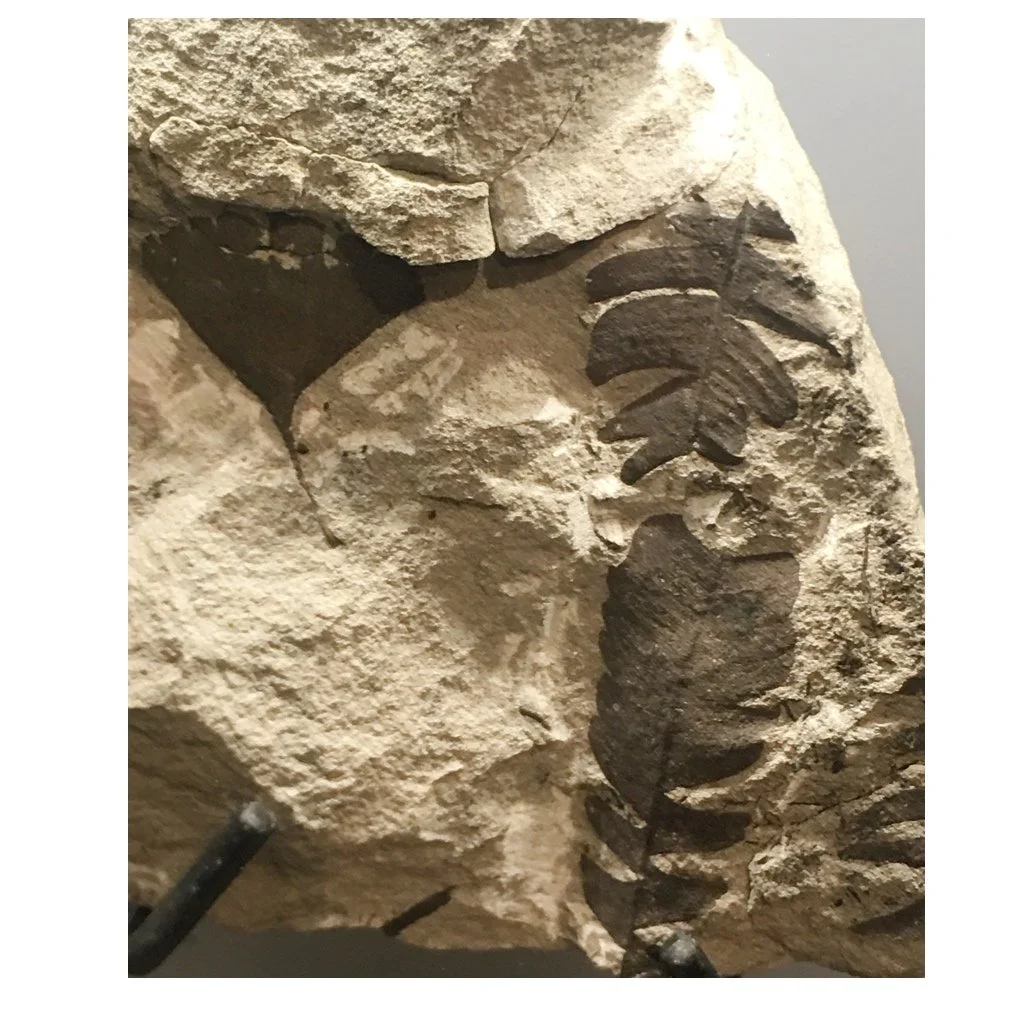
Ginko sp
69 million years
Late Cretaceous, Horseshoe Canyon, Alberta

Medicine Making: Ginko biloba
Home tincturing can be fun, simple and cost effective. We will use ginkgo as an example as ginko trees are easy to find and identify in Vancouver. In this blog article you will learn about the preparation of medicinal herbs, quality issues in herbal medicine, and how to tincture ginkgo biloba leaves for home use.
Home tincturing can be fun, simple and cost effective. We will use ginkgo as an example as ginko trees are easy to find and identify in Vancouver. In this blog article you will learn about the preparation of medicinal herbs, quality issues in herbal medicine, and how to tincture ginkgo biloba leaves for home use.
Medicinal Herb Preparation
Herbal medicine making is something that I have been doing in my dispensary for over 25 years now.
All the liquid herbs that I make are small batch tinctured from organic or wildcrafted herbs.
Why do medicinal herbs need to be prepared?
Plants have hard parts, like roots, rhizome, bark and leaves, and plants have soft parts like flowers. Our digestive system can’t manage these parts very well and so all medicinal plants must go through some form of pre-extraction preparation before we ingest them. Humans don’t have a strong enough digestive system to get the benefit of the active ingredients otherwise.
Medical herbalism prepares active plant constituents in a variety of ways:

Teas
Teas are a herbal infusion prepared with hot water and left to sit until the active herbal ingredient is absorbed into the water. This is how to prepare soft parts of plants such as the flowers or soft leaves.
Tinctures
Preparing a medicinal plant in a liquid form is called tincturing. Tincturing is one of the most simple and effective ways of extracting the active ingredients from plants and used for the harder bits: root, rhizome, leaf and bark of plants.
Some active medicinal ingredients of plants are more absorbable in water, and some are only absorbable in alcohol. The percentage of alcohol which is used to prepare a particular herb is determined by what the active ingredients are. Some plants will require a higher alcohol content than others. When tincturing, one of the things you’re going to need to know about the plant you want to tincture is the alcohol percentage needed.
Traditional Chinese Medicine (TCM) Medicinal Teas
Some TCM formulae are dispensed in granule form, which is easily spooned out and made into a tea/drink by adding hot water. These formulae are pre-prepared by first converting the plant material into a tincture, and then taking this tincture form of the plant and spraying it onto a drying sheet. The resultant dried material becomes granules, which are packaged up and which then can be reconstituted by adding hot water.
Capsules and Tablets
Some products are capsules containing ‘dried herb’. I would advise being careful about buying dried herb encapsulations. As I am sharing with you here, all plants need to be prepared before taking them. If you are purchasing a dried encapsulated herbal product, check for disclosure whether the product has been prepared or not, or how it has been prepared. If it has not been properly prepared, it is unlikely you will be getting benefit from it.
Quality Control in Herbal Medicine
As a consumer, you’ll want to be aware that there can be serious quality issues in the herbal medicine industry with substitution, dilution, quality of product and addition of fillers.
If you are going to be purchasing herbal products in Canada, purchase a quality product, hopefully one where the company knows how to work with herbs in a quality way. Do your homework, find out the background about the company and their manufacturing standards.
Mediherb is an Australian company and the gold standard for herbal medicine making. It’s the only herbal company I carry and trust in the clinic. Quality control is a large topic and I’m not going to go into it in this blog post. You can find information for Mediherb here https://mediherb.com.au/
Mediherb tablets are pre-prepared herbs which have then been dried and shaped into a tablet with minimal filler. You will also notice the pleasant addition that these tablets are coated so they go down almost unnoticed. I like this very much about their products. So if your purchase is a tablet which is not Mediherb, do your homework and check the background manufacturing process of the company.
Step by Step: How to Home Tincture Ginko leaves

Botanical Name: Ginkgo biloba
Part used: the leaf
Percentage alcohol: 25%
The ginkgo tree is an ancient tree extending back to the middle Jurassic period, approximately 170 million years ago. The ginkgo tree has survived several extinctions. You will notice the distinct leaf shape is unusual being fan shaped with veins that radiate out.
Actions: antioxidant, neuroprotective, cognition enhancing, and helps with microcirculation, which means the very small capillaries in the hands, feet, brain (so used for memory and cognition).
Uses: Raynaud's syndrome, increasing peripheral circulation, macular degeneration, increasing retinal blood flow, alzheimers, and vascular dementia.
Please note that Dr. Doan accepts no liability whatsoever for any decisions that I may make for my health based on reading this blog article. The information in this blog is meant to educate only and does not constitute medical or naturopathic advice and makes no claim or promise that any product or service that may cure any condition or ailment. Always consult your doctor or naturopathic physician when it comes to your personal health, or before you start any treatment.
Step 1: Collection
It’s important to have a way to accurately identify what a true ginkgo leaf looks like. I have an app on my phone now, called ‘seek’. It helps me with plant identification and I have a reliable botany resource book. When you have found your ginko tree, choose healthy green leaves, and collect away from industrial centers or highways. Try to collect the fallen leaves; leaves have important functions in the life of a tree.
Step 2: Preparation
Now that you have collected your ginkgo leaves, you are going to need to prepare them. Wash them in clean water, and chop into smaller pieces, roughly ½ inch.
Find yourself a large glass container with a secure lid. When I first started tincturing, I would go into a sandwich place like Subway, and ask them for their huge used glass containers.
You are going to need to purchase some kind of vodka product. Most vodka is around 45%.
Step 3: Take a Breath: here comes the math
If you have purchased a 45% alcohol product, you can dilute your vodka roughly in half with purified water, to get to your (roughly) 25%.
For our purposes here, we will tinctures a 1:5. This means that there is one part of herb material to 5 parts of your alcohol/water mixture.
In the clinic, I tincture one pound of herb at a time, and I make 1:5 tinctures. You don’t have to have one pound of herb, you can take the calculations below, and adjust to the amount of herb you have collected.If you have collected ½ pound of leaves, then adjust the numbers below as needed.
One pound is equivalent to 454g. When we make a 1:5, the total of alcohol/water mixture is 454 times 5 = 2270 mls of your 25% alcohol
Therefore you will need 2270ml of 25% alcohol to make 1 lb of ginko leaves.
Divide this appropriately depending on the amount/weight of your harvest.
Step 4: Create your tincture
Once you’ve done the math to determine how much liquid you need for the weight of herb, place your chopped herb and your 25% alcohol/water mixture in the glass jar, and put the lid on. Shake it up to make sure it’s all blended together.
You are going to leave this mixture to percolate for about 2 or 3 weeks.
Gently shake your mixture daily, for about 1 minute to make sure all is blended in the jar.
Step 5: Decant your tincture
Decanting is where you separate the herbal solid part from the now liquid herb.

Do this after your 2 or 3 week period.
Use a strainer to strain off the liquid, place the liquid tincture in another glass container.
The solid left over herbal material can now be composted.
Step 6: Congratulations
Give yourself a pat on the back….you have made a tincture!
It looks and smells rich and delicious. Your tincture can be stored outside of the fridge as it is an alcohol blend.
Please make sure that you store this tincture safely away from children and keep in a cool, dry place.
Please note that Dr. Doan accepts no liability whatsoever for any decisions that I may make for my health based on reading this blog article. The information in this blog is meant to educate only and does not constitute medical or naturopathic advice and makes no claim or promise that any product or service that may cure any condition or ailment. Always consult your doctor or naturopathic physician when it comes to your personal health, or before you start any treatment.

What to Do When Diet Isn't Working
We are a diet crazy society at the moment. Are you Paleo? anti-inflammatory? carb free? fruitarian? vegetarian?
Confused? don’t know what to eat anymore?
The first mistake you might make is thinking that any one ‘diet’ will work for you. The diet that works for you has no name. It is a custom diet based on the individuality that is you. To think you are going to be able to pick up a book and follow the blueprint in the book probably won't work for the long run.
We are a diet crazy society at the moment. Are you Paleo? anti-inflammatory? carb free? fruitarian? vegetarian?
Confused? don’t know what to eat anymore?
The first mistake people make is thinking that any one ‘diet’ will work for you. The diet that works for you has no name. It is a custom diet based on the individuality that is you. To think you are going to be able to pick up a book and follow the blueprint in the book probably won't work for the long run. You need to find the food that works for you. In order to do this you have to troubleshoot, tweak and find what works for your body.
If you come to see me and you are on one of these diets and it helps in some way for what is going on for you,
it is diagnostic.
Being on a restrictive diet is not healing, it is coping.
Your body will take you down if it doesn’t like what you are doing. Your body is smarter than you think. Your body is talking to you.
If your car was making a noise, or a red light is going off on the dashboard, you know that something is wrong with the car. You can fix it now or fix it later. If you fix it later, it will be more expensive and damaging to your car.
How to Start
troubleshoot your food
troubleshoot your supplements
troubleshoot the underlying cause
Troubleshoot Your Food
Troubleshooting food is something you can do today. Perhaps this is why it is so very popular right now. You can take steps immediately to make yourself feel better.
The downside of this is that in the long run, stricter diets are not realistic, everyone inevitably falls off the wagon, and the underlying problem has not been fixed.
Feelings of frustration and restriction can lead you to feeling low self esteem and can trigger unpleasant emotional states.
Troubleshoot your Supplements
If you are taking supplements, don’t you think it’s a good idea to understand why you are taking them?
I have patients come in to see me and they have a bag of supplements, from here or there, old and new. Can’t remember where they were bought… why are you taking that? I ask. They have no idea, or forgot. Sometimes products overlap/do the same thing or have similar ingredients in them. In the long run, it will save you time, money, and effort to have your supplements reviewed.
Some people don’t take supplements because they think they don’t work.
Anything taken in the incorrect dose will not work.
Anything you buy which is poor quality will disappoint.
Absorption is an issue. What you are buying may be great, however your digestion is weak and you cannot tolerate or absorb it: it’s a problem.
If there is a reaction happening with the supplement you are taking, it could be diagnostic.
Troubleshoot the Underlying Cause
Don’t get me wrong: a good diet is massively important. It will alleviate alot of problems and keep you healthy. Most people come to real food diets because they are sick: female hormonal problems, weight issues, fatigue, depression, heart disease, autoimmune disease, cancer, chronic fatigue syndrome.
As a diet obsessed culture we very much like diet as a solution. Many people are not capable of considering anything beyond it. We also like to be in control. Diet also looks and feels like you are doing something. It may be the wrong thing, but at least it looks and feels like I have some control over my situation.
A good diet is the foundation to good health, but it is not the only answer and will not solve the root or underlying cause. Most symptoms tend to go deeper than diet and supplements.
The Underlying Cause
The deeper underlying cause is something that takes time to explore. Do you think you could look beyond what diet may have to offer and see what else is available for healing? We cannot get away from exploring stressors, whether they be emotional stressors, mental or physical stressors. Sometimes the first step is basic testing for adrenal function, which measures the impact of the stress you have been in before you have come to the clinic. Be careful not underestimate the effects of chronic stress.
Some people have been under unbelievable stress, stress which puts them into a catabolic state, breaking down body systems and causing inflammation. You could be so used to feeling terrible you have forgotten how to feel any other way.
Mental and Emotional Stress
Think outside of the box: consider the healing possibilities of homeopathy. Homeopathy leverages your innate healing ability to alleviate suffering and ease pain. Integrative Body Psychotherapy can go a long way to resolving unhelpful patterns of behaviour which cause stress and fatigue (or 'deadening' of inside spaces), or help to move through grief.
Physical Stressors: Gut Infections
Do you know that 80% of your immune system is in your gut? GI infections, parasites, bacterial infections, gut dysbiosis could be the root causes of issues you have been experiencing. Some people have so much mould, yeast and infections in their gut that this creates toxicity and brings down the immune system. Infections are found through stool testing, and just like practitioners not all stool tests are created equal.
You may wonder how your digestive system is involved if you think you have no overt Gi symptoms. Menopausal symptoms, female hormonal complaints, weight issues, depression, fatigue and other inflammatory issues such as autoimmune conditions, skin conditions, cardiovascular issues, and cancer will have GI involvement:
Sixty percent of GI infections have no GI symptoms and the symptoms will appear as something else.
Anytime we are having hormone problems, we are having gut problems. Whether it is adrenal fatigue, thyroid problems or female/male hormonal problems. If you are under stress, the death of a loved one, a divorce, stress with work or positive stress from a pregnancy or marriage, you may develop hormonal imbalance.
What to do about it?
A good diet is just the beginning to a foundation to good health. It is certainly not the only answer and will not solve the root or underlying cause of your difficulties. If you want to work towards going deeper, with more permanent results, I can help.
It will take a little time but my prediction is you will be surprised at how pleasantly better life can be in the long run.

Breathing helps with Stress
When you breathe in, you breathe in all the things that your body needs for life. You breathe in oxygen which perfuses your tissues and muscles and organs. When you breathe out, you breath out carbon dioxide, carbon monoxide and other gases which are toxic and would kill you if you didn't breathe them out. Through a process called photosynthesis, leaves pull in carbon dioxide and water and use the energy of the sun to convert this into chemical compounds such as sugars that feed trees. But as a by-product of that chemical reaction oxygen is produced and released trees.
How you breathe is literally how you do life…
You are part of the cycle of life.
When you breathe in, you breathe in all the things that your body needs for life. You breathe in oxygen which perfuses your cells, tissues, muscles and organs. When you breathe out, you breath out carbon dioxide, carbon monoxide and other gases which are toxic and would kill you if you didn't breathe them out. Through a process called photosynthesis, leaves pull in carbon dioxide and water and use the energy of the sun to convert this into chemical compounds such as sugars that feed trees. But as a by-product of that chemical reaction oxygen is produced and released by trees.
How you breathe is literally how you do life.
Imagine when you breathe in, you are breathing in that which you need.
When you breathe out, you are exhaling what which you don't need or don't want. Letting go of things you don't want: exhaustion, stress, responsibility, headache, body pain etc.
Observe the quality of your breath. Is it easier to breathe in. Is it easier to breath out. Is it easier to take in life, or let things go. How you breathe is how you do life.
Breathing bridges both the voluntary and involuntary nervous system.
It is both a voluntary and involuntary activity. By voluntarily manipulating your breathing, a person can affect his involuntary responses.
The body has two nervous systems: the central nervous system or voluntary nervous system and the autonomic nervous system, which is considered involuntary. The central nervous system controls muscular movement and voluntary responses. The autonomic nervous system controls the function of organs, breathing, emotions (through the endocrine system) and it also is concerned with sexual response (through the endocrine and circulatory systems).
Breathing is the only way we interface between the sympathetic and parasympathetic nervous system. Try to control your heart rate...you can't. However you can control your breathing, purposefully slow it down and deep or make it more rapid.
If a person is under stress, the sympathetic nervous system reacts as if he were in actual physical danger (increased heart rate, etc). This continued reaction can cause symptoms of stress. A person can be taught techniques to release the tension by learning to activate the parasympathetic nervous system, bringing into balance with the sympathetic side. Its about balance.
The parasympathetic side of the nervous system is calming, the more subtle relaxed side that allows for pleasure and free flowing feelings. This is also where healing takes place. Ideally there is a balance between the two systems, and this can be achieved by changing a person's breathing pattern. If a person is tense and fearful, moving the breathing to the belly and slowing it down will activate the parasympathetic system and calm the person.
Breathing is how we oxygenate the tissues of our body
Imagine when you are breathing, you are oxygenating all the tissues, cells, muscles and organs of your body. If you take 10 proper big breaths, image how much oxygen is getting to these tissues and organs. This is one of the least expensive and healthiest ways to get precious oxygen into your cells.
Breathing is an important tool that can bring us back to presence
There are times when we are in a place where we don't know what to do.
It feels as if everything is going wrong, the world is collapsing around us, the sky is falling, we are being hailed on, hammered and it won't stop.
If you can only do one thing, that thing is stop and breathe.
Breathing will help to ground, and shift your energy. It can bring you back to a felt sense of self. Ten breaths will bring oxygen and vitality to your body and activate the parasympathetic nervous system. Then take another 10 breaths and look around.
See how the world is different.
The Nervous system, vagus nerve, adrenal system and breath work
There is a body of work around the vagus nerve, our nervous system and how it is connected to the adrenal system and therefore our immune system and relates to anxiety and depression. Breathwork is the main ingredient in vagal toning.
If a person is under stress, the sympathetic nervous system reacts as if he were in actual physical danger (increased heart rate, etc). This continued reaction can cause symptoms of stress. A person can be taught techniques to release the tension by learning to activate the parasympathetic nervous system, bringing into balance with the sympathetic side. Its about balance.
The parasympathetic side of the nervous system is calming, the more subtle relaxed side that allows for pleasure and free flowing feelings. This is also where healing takes place. Ideally there is a balance between the two systems, and this can be achieved by changing a person's breathing pattern. If a person is tense and fearful, moving the breathing to the belly and slowing it down will activate the parasympathetic system and calm the person.
Breathing and breathwork is part of Awareness Integration work. You can learn more about it here.

The Primary Scenario: Uncovering Generational Themes
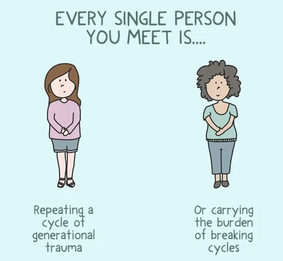
The term ‘primary scenario’ is an Integrative Body Psythotherapy term. It is a way of exploring Intergenerational themes. You may have done this before working with different kinds of counsellors or personal work. You may have heard the word ‘family tree’ believe me, this not your average family tree.
“It includes the family wisdom, and it’s folly, prejudice and values. It includes all personal tragedies as well as global ones. It includes reactions to the new baby. Everything a baby learns about relationships, love and hate, pain and pleasure, fear and security, comes from the people of his primary scenario. His character structure grows in direct response to it”.
- Jack Rosenberg, Body Self and Soul
What is a Primary Scenario
The term ‘primary scenario’ is an Integrative Body Psythotherapy term. It is a way of exploring Intergenerational themes. You may have done this before working with different kinds of counsellors or personal work. Different styles have slightly different approachs and different words for this. You may have heard the word ‘family tree’ believe me, this not your average family tree.
Hahnemann, the father of homeopathy, was the first to introduce the concept of miasm, or intergenerational energy patterns. A miasm is an energy pattern which is passed along through the generations. You have inherited not only the colour of your eyes from a parent or grandparent, but also a bundle of things passed down to you, things which may not be yours, but left for you to deal with.
When I work with my clients with homeopathy, doing a primary scenario helps me understand more deeply what themes are there, so I can make a deeper and more complete prescription. We are so fortunate to have tools and resources so that this kind of healing can begin to take place.
My clients experience their family mapping in in a somatic way. I help them track the sensations they feel in their body each step along the way while we are on this journey together. We learn the childhood themes of emotional injury and learn which themes are more likely to fragment you.
Your primary scenario is a sacred thing. It is your life blueprint.
What are the need-to-knows
It’s a different appointment type with me. We book 1.5h of time, and there is a block of butcher paper put on the wall so we can trace together 3 generations of your family. It’s like going to a movie together. There is no prep work for this, although some people like to look up birth years.
You take the butcher paper with your primary scenario home with you and use it as a resource. It’s used in our ongoing work together to help bring back to comfort when there’s an upset.
How often would I do a primary scenario?
Each time my clients do their primary scenario, they have a different experience and deeper awareness. Some invite their partner to join as an observer, knowing this has real payoff in building strength and connection in partnership.
Learn more about this way of working here

Medical Herbalism for Respiratory Support
Here are some great recipes you can do at home with a few plant medicines
Vapors for Steam Inhalation
Lavender essential oil Lavendula officinalis
Eucalyptus essential oil Eucalyptus globulus
Thyme essential oil Thymus vulgaris
Here are some great recipes you can do at home with a few plant medicines
Vapors for Steam Inhalation
Lavender essential oil Lavendula officinalis
Eucalyptus essential oil Eucalyptus globulus
Thyme essential oil Thymus vulgaris
Actions: This formula is an antispasmodic, antimicrobial and decongestant.
Indications: Vapors from this formula are inhaled directly into the sinuses as an antimicrobial agent. It is most useful for sinus and lung infections.
Contraindications, cautions and words of wisdom:
This formula is to be used as a vaporizer or as a steam inhalation. It is not for internal use.
Vapors for Steam Inhalation Dosage Chart
These are very strong, pure essential oils, so start with a small amount. Use 5-10 drops in a room vaporizer or a few drops in a pot of boiling water if used as steam inhalation. If a stronger dose is needed, increase slowly to prevent irritation of the lungs. If one of the oils is not available or feels too strong, you may choose to use one, two or all three of the oils.
Lavender essential oil, eucalyptus essential oil and Thyme essential oil open the sinuses, dilate the bronchials and kills infectious organisms residing in the respiratory tract.
___________________________________________________________________________
How to Make Herbal Preparation - TEAS
Teas can be made from freshly harvested herbs, or dry herbs. Store dry herbs in an airtight container away from light.
Infusions: Infusions are used for extraction of vulnerable constituents such as vitamins, enzymes and essential oils. The aerial parts of herbs are used such as flowers and leaves.
Decoctions: Decoctions are used for plant constituents that require more time and heat for extraction, such as mineral salts, bitter constituents, and hard parts of plants such as bark, roots and seeds.
How to make one cup of Infusion:
Two recommended methods:
1) Add one cup of boiling water to one heaping tablespoon of dry herb or three heaping tablespoons of fresh herb in an air-tight container like a canning jar.
2) Bring one cup of water to boil in a stainless steel or glass kettle. Remove the kettle from the burner and add one heaping tablespoon of the dry herb or three heaping tablespoons of fresh herb to the water. Cover the kettle with a tight fitting lid.
Steep for 10-15 minutes. Remove the lid, strain and drink the liquid. The tea can be consumed hot or cold, depending on usage. Large quantities can be stored in the refrigerator. Do not store longer than 3 days because it may grow mold. It is best to make teas as they are needed.
How to make one cup of decoction:
In a kettle, bring one cup of water and one tablespoon of dry herb or three heaping tablespoons of fresh herb to a boil. Cover the kettle with a tight fitting lid, and simmer the ingredients for 15-25 minutes. Remove the kettle from the burner and steep ten minutes. Strain and drink.
Immune System and Respiratory System tea recommendations:
Thyme tea, Thymus vulgaris. Thyme is a culinary herb with antibacterial, antimicrobial and has an affinity for the throat, the lungs and respiratory system. Gargle with the tea first before swallowing will help sore throats. The part used is the leaf, and can be infused.
Licorace tea: Glycyrrhiza glabra. Licorace inhibits growth of viruses, is anti-inflammatory, an immune modulator, nutritive and spasmolytic (anti-spasm). Licorace is best known for it’s effect on mucous membranes. It is used in adrenal fatigue, immune deficient states. Due to it’s pleasant taste, it makes a nice addition to formulas which are strong. Licorace should be used with caution with those with diagnosed hypertension. Licorace is a root, and can be decocted.
Astragalus, Astragalus membranaceus. Astragalus is a Chinese medicine herb, which is adaptogenic (this means it helps your body to adapt), antiviral, anti-inflammatory, anti-oxidant and hepatoprotective (helps protect your liver). It is immune enhancing, and is used in adrenal fatigue. The root is used, and astragalus can be decocted.
Garlic, Allium sativum. Fresh garlic contains allicin, a substance with antibiotic and antiviral properties. It’s also good for your digestive system. It has to be fresh garlic. Dried garlic is used for other purposes to do with the cardiovascular system (which you will also get from fresh) but only fresh garlic has the allicin for your immune system. Crush a garlic clove into a cup of hot water with lemon, and you have yourself a nice tea. Don’t add honey. Honey is sugar, and we are trying to stay away from sugar as it lowers your immune system. I know you’ve heard the drink differently, but trust me it’s not a good idea. If you are worried about that garlic smell, remember… people don’t want to be near you if you are not feeling great anyway.
This information is meant to inform only, not provide medical advice. You should always consult your doctor or naturopathic physician when it comes to your personal health, or before you start any treatment.

Homeopathy for First Aid and Travel
Ah the joys of travel! Except of course when something unexpected happens, (and doesn’t it always?) and you are caught unawares in a foreign country. Having a small homeopathic kit nearby with you can save headaches and pain….
Ah the joys of travel! Except of course when something unexpected happens, (and doesn’t it always?) and you are caught unawares in a foreign country. Having a small homeopathic kit nearby with you can save headaches and pain. Homeopathic travel kits are available for purchace, however I like to take with me remedies which can be disposed of. Several times I have had security take a remedy from me and if you are travelling with your expensive beautiful new kit, you don’t want to lose it. Also keep in mind, that the country you are travelling in, especially in Europe, may be homeopathy friendly so remedies could be purchased at your local pharmacy. I find travelling in France, that any local pharmacy is well stocked with remedies if you give them a day’s notice.
Here are some tips as to how to create your own custom kit and what to include in it.
Choose a sturdy pouch
Choose a sturdy portable container which closes with no off gassing of plastics or other odours. If there is a plastic smell or even a chance of it, don’t use it. Make your kit small, readily portable and easy to find in your pack. My kit currently consists of two 4” sturdy pouches I obtained from flying Emirates airlines which I think contained things like eye covers etc.
Choose your remedies
When setting up your first aid kit, be familiar with the remedies you choose. There are alot of remedies to choose from; include only what you think you will need and can use confidently. It is my experience that it’s a good idea to include emergency remedies which you might not think you’ll use, because in my experience, inevitably something happens when I’m gone which is a surprise. Particularly don’t forget arnica, aconite and arsenicum.
Below are some remedy suggestions. Choose what you think is appropriate to the region and style you are travelling. Print this out and keep it onhand, or write a summary in your own words.
Aconitum Napellus
Aconite is especially useful for two things: Beginnings of cold or flu, and shock.
Aconite for influenza, colds or high fever brought on by exposure to the wind/elements. it is only useful for the initial stages, if illness has set in, move on to another remedy. In TCM, this would be called a ‘wind cold’ invasion, those days when it is cold and windy outside and you come in to a warm room and next thing your throat is sore or your ear hurts and you think oh no! I’m going to get sick. This is also the situation in the summertime of being under/in an airconditioned room and going out into a warm day and feeling unwell. Aconite is regularly prescribed by me for airplane travel, to prevent sickness coming off and going on the flight.
Aconite is for shock: Complaints after a fright or sudden, shocking events, such as a car accident or earthquake. This medicine is used for animals who are affected by loud noises and fireworks. It is for shock and fear after injury, exposure or accidents.
Apis Melliifica
Apis is a first choice remedy for bites and stings, and wasp and bee stings where there is swelling, redness and pain. The affected area will feel hot and sensitive to touch. Apis can also be used for hive reactions and severe allergic reaction, where there is swelling of the face, lips, tongue and throat (NB hives can be lifethreatening and an epipen and hospital visit may be needed). Apis can be used for cystitis, where there is burning and stinging pain on passing urine. Remember red, swollen hot and the pain is described as stinging or burning. Apis types can appear busy, vital, fussy, irritable. Use a 30c potency every few hours until pain subsides.
Arnica montana
Arnica is the first choice remedy in any emergency, accident or first aid situation. Arnica is used for bruising, strain, sprain, twists, broken bones, and bleeding caused by injury. Arnica is also effective to calm the shock of an accident. Arnica can cut the time it takes to heal an injury in half. Arnica can be given before surgery, dental treatment or childbirth. Think of arnica when the person says he is fine (which is very unlikely) and won’t let you near the injured area. Many surgeons now prescribe arnica before and after surgery to speed healing time.
Arsenicum album
Arsenicum is a first choice remedy for food poisoning, with simultaneous diahorrea and vomiting. Some of the features of this medicine: the patient is often anxious and restless, the pains are burning, it can be used for gastritis with vomiting and diahorrea, or diahorrea alone. I have saved many pet owners a trip to the vet by suggesting arsenicum for their vomiting pet who has eaten something unknown. Give 30c every few hours.
Belladonna
Hahnemann proved this remedy in 1799, and used it to successfully treat scarlet fever. Belladonna is a first choice medicine for fever. It is most often used for children in fever and teething complaints. Belladonna can also be effective for pounding or migraine headaches where there is heat and throbbing pain and a red, hot face.
I use it more for children than in adults: It can be used for earache and teething pain in children, as well as high fevers and teething complaints.
The key features of belladonna are: heat, redness, sudden onset, throbbing pains/conditions, redness, heat, delirium: dilated pupils, shining/glaring eyes.
Most sunstroke responds well to Belladonna. Give 30c potency every few hours with hydration.
Bryonia alba
Bryonia is used primarily for slow starting ailments with pain on slightest movement. Bryonia can be used as a first aid remedy in colds and flu. This is an effective remedy for very dry sore throats. In sickness, the patient is irritable like a bear, wants to be left alone. The slightest movement aggravates the condition. Everything is dry, dry throat, dry eyes, mouth, lips are dry. The patient gulps cold water. The flu progresses slowly with aching. Bryonia can be used for headaches, which are worse for jarring. I have used it effectively where people the jarring from a sneeze and or cough from a cold causes a headache.
Cantharis
Cantharis is a first choice medicine for painful burns and scalds in the home. It takes away the pain, and if it is a major burn a medical attention must be sought. Cantharis can also be used to treat sunburn along with belladonna for sunstroke. It can be used for the pain of burning and scalding pain of urinary tract infections in women but other remedies can be more effective and remember that cystitis must be treated by your ND or MD.
Chamomilla
The use of chamomile in medicine is ancient, going back to the time of Hippocrates. Chamomilla is most useful homeopathically for children’s teething complaints that are accompanied by fever, and where children insist on being carried. This is useful for pain and an angry, accusatory reaction to that pain. Chamomilla useful for earache where there is a blocked feeling, and colic and sleeplessness in inconsolable children. Give 30c potency given hourly.
Gelsemium
Gelsemium is the first choice remedy for influenza. The patient is completely exhausted/ paralyzed and mentally alert. Especially with shivering up and down the spine. Also it is a fever remedy, for symptoms such as sweaty, flushed face, and unpleasant taste in the mouth, furred, trembling tongue, cold chills and a lack of thirst. Gelsemium is also an excellent remedy for stage fright. The patient has a general situation of weakness and inability which paralyzes him when he must confront any challenge. I prescribe it often for the severe anxiety of tests, interviews and performances. Use a 30c potency several times before the event as soon as the anxiety begins.
Hepar Sulphuricum
In the 18th century, Hahnemann used the homeopathic remedy as an antidote for the side effects of mercury which was used extensively in the treatment of many illnesses. Hepar sulph is mostly used in very sore throats where the sensation is like glass or splinter like pains. Hepar sulph can be used when there is an infection, for example, tonsillitis and earache. This remedy helps expel pus such as in infected pimples in acne, or boils that are sensitive to touch and ready to burst (where a doctor must be seen). Use a 30c potency every 30 min for sore throats.
Hypericum.
The 16th century herbalist John Gerard described this brightly flowering herb as ‘a most precious remedy for deep wounds’. Because the juice from the crushed flowers is blood red, it was thought to be a good wound herb. Today it is used in herbalism to treat depression, nerve pain, and fevers.
In homeopathy Hypericum is an injury remedy, especially painful injuries where nerves are damaged. Think of crush injuries to fingers and stubbed toes. The quality of hypericum is the sharp, shooting quality of the pains.
Effective for: contusions, lacerations, punctures to parts rich in nerves such as tips of fingers, tongue, teeth, eyes, genitalia. Pain after dental procedures. Injury to larger nerves: laceration. Injuries of the spine such as fractures or sprains, with sharp shooting pains. It is effective for concussion with sensations in the head such as an ice-cold feeling, and eye injuries. It is an excellent first aid remedy for puncture wounds, from nails, splinters, bites and crushed fingers or toes.
Nux vomica
Nux vomica is for stomach pains, headaches and hangover caused by overindulgence. Nux-vomica enjoys rich food and high living and is the classic type ‘A’ personality. High strung and energetic, competitive achievers, they work and play hard. Because they are type A personalities, the typical nux vomica patient will crave coffee, alcohol and stimulants such as spicy foods. They are angry and impatient people, intolerant of criticism toward themselves, they are highly critical of others. Nux vomica is a great hangover remedy! Nux vomica and arsenicum are both remedies used for digestive disturbances. Nux vomica gets stomach pains, cramping or sharp pains in the abdomen, worse from anger, worse from tight clothes, and remember they like to eat spicy, hot foods.
Pulsatilla
Pulsatilla is mostly a children’s remedy, The typical pulsatilla child is shy and clings to the mother. She makes good contact with the doctor from the safety of the mothers lap, and she is vulnerable to other children, easily bullied. It is an excellent childrens remedy for ear pain, acute and chronic otitis media. It can be a good cold remedy with lots of mucous, with either a runny or blocked nose, sinus congestion and a loose cough with greenish yellow phlegm.
Rhus Toxicodendron
If touched, poison ivy causes a violent skin eruption, often with fever, loss of appetite, a headache and swollen glands. Poison ivy was first used medicinally in the 18th century when a doctor observed that a patient was cured of herpes of the wrist after being touched by it. The plant has been used in orthodox medicine for rheumatism. The Rhus tox patient is restless, and this remedy can be used for skin complaints which are burning, itchy, red, and swollen. It can be used for poison oak and poison ivy, shingles and herpes eruptions and diaper rash. The eczema of rhus tox has small vesicles which are intensely itchy. Rhus tox can be used for arthritis pains, chronic or acute rheumatism which is worse in the night in bed, worse in the morning on waking, worse in damp and cold weather or before storms, worse for exertion. It can also be used for bursitis, tendonitis and sprains if the symptoms fit.
Potency
Most first aid kits will be found in a 30c or 200c potency. Basically, give what you’ve got. The most important factor is selection of remedy.
I highly recommend keeping a First Aid kit in your home. First Aid kits can be purchased at the clinic. We carry Helios First Aid kits which come with a sturdy carry box and an informative leaflet which describes each remedy in detail and each complaint where a remedy would be useful.
Preventing and Treating Flu-like illnesses
In these times of varying health reports in the media, it can be confusing. It is the position of this clinic that continued ongoing homeopathic and naturopathic care is your best 'defence' regarding acute colds and flus. If you are already coming in for homeopathic treatment, you are already doing your best for your health by strengthening your overall system in a holistic way.
In these times of varying health reports in the media, it can be confusing. It is the position of this clinic that continued ongoing individual homeopathic and naturopathic care is your best 'defence' regarding acute colds and flus. If you are already coming in for homeopathic treatment, you are already doing your best for your health by strengthening your overall system in a holistic way. Traditional Chinese Medicine also has some powerfully effective strategy and treatment to treat colds and flu.
It is considered that getting a cold or flu once or twice a year is a sign of a normally functioning immune system. If you are falling ill more than this, this is your indicator to seek help. It is important to come into the clinic when you are sick, Hahnemann states that in observing the acute state, key information can be obtained by the physician.
If it is your time then let's make your experience as kind as possible. The coughing, spluttering, sneezing, fever is your body taking you through a natural detoxification process.
Below are some tools to stop you getting sick (if your body wants to truly be sick these will not work) and also how to be more comfortably sick and avoid complications. The goal is to be comfortable and to ensure no complications (such as ear infection, bronchitis or pneumonia). In this way your body can do what it needs to do, resolve it and move on. Adults and children who are unwell and limp/miserable/unhappy need guidance and this is an indicator to come in for an appointment.
These are some guidelines to help you through this fall and winter season.
Stage One of a Cold or Flu
In Traditional Chinese Medicine (TCM) there are 9 stages of a cold or flu. The early stages are often triggered by the environment, coming in from the cold or wind and noticing your ears are ringing, or your throat is sore. This is the 'oh no' moment, where you realize you are on your way to getting sick. Some classic signs: you feel suddenly tired or weak, you have a headache, your throat is sore, your ears are ringing. These are often after some environmental exchange.
The homeopathic remedy Aconite 30c is very effective for this state and if taken early enough will resolve the issue and your symptoms will disappear. If you wait too long to take the remedy (if stage 2 is reached) it will be too late. Also if you body is intending to be ill it will not work.
Jade windscreen formula is another TCM formula designed to strengthen your protective Qi, or Wei Qi. This formula can be used to protect yourself if you are around those who are unwell.
Later Stages
There are several things you can do to help yourself be more comfortable if you become unwell. Here at the clinic, we recommend our Immune Tincture containing Usnea barbarata, one of the most potent anti-viral and anti-bacterial plant medicines. Read the blog post on Usnea barbarata.
Bedrest. One of the least expensive and more potent treatments is bedrest. This is where your immune system does it's best work.
Vitamin C. Vitamin C is important for strengthening the adrenal and therefore the immune system. Take up to 6g (6000 mg). Vitamin C does not have to be expensive, look for powders or buffered C products.
Cooked foods. Avoiding cold and raw foods will strengthen your immune system. In TCM, soups and stews made with chicken and barley are recommended.
Important
Sugar in any form (including honey, fruits and white flour) directly lowers the immune system by lowering the white blood cells (defence cells) which destroy pathogens (viruses and bacteria). You may notice that if you have sugar, even a small amount, you will feel worse.
Ongoing homeopathic and naturopathic treatments will resolve issues of getting ill more than once or twice per year for a longer time than normal.
If you feel uncomfortable or not well enough to come into the clinic, a phone or zoom (online video) call can be set up instead, just call the office and let me know. Having a cold or flu or feeling unwell isn’t a good reason to cancel or postpone your appointment; remember this is the doctors office, you need support and you need it now.
How to Restore Balance: Hiding Under the Covers
Hiding under the covers is something that I regularly prescribe and encourage. It is a mental health day, a restoration day to be used in when feeling burned out, fighting a lot of colds, having a lot of headaches or feeling moderately depressed and don't know why. I am writing this blog before Christmas and it is my experience that the month of December is very stressful. Many people start to twitch in December.
Hiding under the covers is something that I regularly prescribe and encourage. It is a mental health day, a restoration day to be used in when feeling burned out, fighting a lot of colds, having a lot of headaches or feeling moderately depressed and don't know why. I am writing this blog before Christmas and it is my experience that the month of December is very stressful. Many people start to twitch in December.
I am sharing an excerpt taken from Jennifer Louden’s book The Woman's Comfort Book. This is a guide self nurturing and restoring balance in your life. There was a time when this book stayed by my side. Fatigue often means we can't come up with ideas as how to care for ourselves, and this is a great resource. She has also written The Couples Comfort Book which is a resource for couples.
What is it?
Hiding under the covers is a planned retreat, a healthy way to care for yourself. Give yourself permission to stay in bed or on the couch for a day and do whatever you like. That may be sleeping, eating, reading, watching old black and white movies or a combination of these. This may sound indulgent but it isn't!
Hiding under the covers is a variation of playing sick. Remember when you were a child and you would stay home from school, sick enough not to feel guilty, but not so sick you couldn't enjoy the food your mom prepared or watching 'Leave it to Beaver'. This is the warm, safe feeling you need to recreate.
Allowing yourself to retreat gives you the critical time you need to reflect on your life and balance yourself. By taking time for yourself in such a lavish way, you are saying to your mind and body 'I deserve the same amount of love and care I give to others.'
You'll need:
Your bed or couch.
Fluffy blankets and lots of pillows
Snack food, books, magazines. Whatever fun and silly things make you feel good.
When to do it:
when you are so burned out you can barely keep going.
When you keep saying to yourself "I'll just power through this," or "if I just keep my feet moving," or " Once I'm finished with this project, I can rest."
When you have been fighting a cold or have been having a lot of headaches.
When you have been feeling moderately depressed and don't know why.
When you never allow yourself to just lie around and relax.
What to do:
Banish Guilt!
The key to getting comfortable with hiding under the covers is to give yourself permission to take time off and crawl into bed without berating yourself. A good way to do that is to turn off your annoying inner critic. The inner critic may say things like, "You can't do this, people are depending on you." "Sleeping, in the middle of the day? What will you sink to next?" "What a wimp, in my day..."
Gently tell yourself with your nurturing voice that by taking a day off and allowing yourself to be blue or tired you are performing a very important duty. You will be better to others, more effective at your job and a more enjoyable person to live with if you take time out.
Arrange your Hiding Space
Make the space where you plan to spend the day as comfortable as possible. That may mean blobbing out on the cough, under a heap of cuddly blankets. Or hide your partner's dirty socks, make the bed with clean sheets and stock your bedside table with hot cinnamon tea and sourdough toast (or gluten free toast!). Whatever appeals to you.
Screen your calls
Turn on your answering machine or unplug the phone. Talk only to people who help you feel better. Avoid all unnurturing people.
Scent the Room
Hide a couple of scented sachets between the blankets.
Bake cookies.
Open the windows and let in fresh air.
Put a freesia or rose in a vase on your nightstand.
Literary Fun
Immerse yourself in a good or distracting novel. Browse in a bookstore and stock up on a few titles or tuck away for your next day off.
Munchies
Create a tray of food to have in bed. Consider an attractive place mat and your pretty dishes. Try a bowl of grapes, some chocolate, whoever your body craves.
Television
Watching television on your hiding time can be good or it can be bad. Long hours infront of daytime TV can end up making you feel more tired and stressed than before. But if you never get to watch daytime TV, maybe this is just what you need.
Get into the habit of having old movies on hand to watch on these mental health days. Renting a familiar film can be very comforting. Suggestions can be...Field of Dreams, The Women, any movie with Katherine Hepburn and Spencer Tracey, Princess Bride, etc.
Again and Again
Practice makes perfect. Take a hiding out day to see what you need to feel refreshed and renewed. Follow your desires. Indulge yourself.
A whole day isn't necessary, though it is nice. An hour or two on a Saturday morning, leaving work early, skipping a dinner party you didn't want to go to...the options are endless.

An Attitude for the End Zone
When Doris Grumback was 70, she wrote Coming to the End Zone: A Memoir. The End Zone is that time of life when you must be conscious or you will miss the rest of your life. It could start at anytime, but by the time you are 60, you automatically begin to feel like an elder, at least older than most and more experienced than many.
Here are some random thoughts about the End Zone from Jack Rosenberg (Author of IBP: Body, Self and Soul)…
When Doris Grumback was 70, she wrote Coming to the End Zone: A Memoir. The End Zone is that time of life when you must be conscious or you will miss the rest of your life. It could start at anytime, but by the time you are 60, you automatically begin to feel like an elder, at least older than most and more experienced than many.
Here are some random thoughts about the End Zone from Jack Rosenberg (Author of IBP: Body, Self and Soul):
That which is most important comes first. Listen to your body voice. When you seek approval from others, it stops your internal aliveness, sense of well-being and in the end zone, it will limit your sense of freedom. When you make decisions, you can't check with everyone in the past on whom you have counted to tell you what to do or what to rebel against, most of your trusted advisors have died anyway.
You need an intention, not a goal, to accomplish what you wish to accomplish in the rest of your life. Do not make a plan so ambitious that it cannot be completed. A goal so immense that it occupies your life is a trap and keeps you from living in the end zone. Don't make a "when....then...." out of the last years of your life.
Love and companionship outweigh what looks like right or pleases someone else.
References to why-you-are-the-way-you-are are no sufficient justification to stay the way you are.
Beauty is not external. What the light bulb looks like is not as important as the quality of the illumination cast from within.
God doesn't care about your intentions, nor does he count good deeds from the past. Every moment is a clean slate and there are no report cards (except those given from within).
One moment of truth is work a lifetime of half lies.
Work must have personal meaning. To work only for money or fame is too costly to the soul.
"No one can tell me what to do" is a closed system, closed to life. It can cripple intimacy and your sense of self, personal growth, and spiritual awakening. A closed system is just that, a closed system. It is not a sign of power. It's perpetrators often find themselves emotionally shallow and spiritually empty, with the finish of life coming up fast.
The end of any human endeavour is not the end of aliveness nor can it be the beginning. The energy for closure is used for just that, for closure, for ending. This completion can bring peace and joy, a feeling of moving on, of passage. The energy for beginning, however, is excitement for new life. It is a separate event. Beginnings take just as much energy as endings do. Both are necessary. For life in the end zone, life starts anew each moment.
Not every advance in technology is automatically good. We may, for all our inventions, have progressed no closer to God than when we were paelolithic hunters and gatherers. We may, with all our gadgets and short cuts, have lessened our ability to be human, to feel, to love and share with our fellow man.
Spiritually and godliness cannot be worn like a bulletproof vest against the pain of being human or as protection from intimacy.
You must actively choose your friends. There is no time to be with people you don't particularly care about. Don't let such people choose you and steal your time. Want them, or let them go.
Remember, change is really the only constant in any relationship.
Any relationship that isn't reciprocal in some way won't be fulfilling.
Humor is more important than drama. There is enough drama in just being alive and staying conscious.
Your adult children must be given respect for their capacity to solve life's problems on their own. When you tell them the answers you are often speaking of your own answers, not theirs. When you do this, you treat them as though they were extensions of yourself. Their lives are not your life. The true meaning of live is freedom and respect.
If you cherish someone so much that you never cut the cord, he or she never gets the experience of flying freely in life.
Each day have one question, prayer, a thought about God or the meaning of life.
The end zone is not the end. It is the beginning of a way of a way of being that has no time for anything that does not move forward towards aliveness.
As we age, we are forced to seek that which brings us excitement or aliveness because it doesn't seek us. We have to conserve our physical and emotional energy so that it will not run out before we finish the race. This insight may come after a serious illness or tragedy that awakens us to life but it must come by the time we are 60 or we will miss the end zone.
If there is something unfinished in your life that you feel is important to your destiny, you must move toward its completing. If it cannot be finished, and you have no control, let go or you will be stuck holding onto a permanent drain in your life force.
One of my basic assumptions of life is that life force, or energy, is very much like the Chinese concept of Qi, in which each person, at birth gets a measured amount of Qi, energy, or life force (I use the phrase 'life units'). Some of us get more of it than others. When we are young we are mostly unconscious of any need for conservation of energy or Qi, so we can push ourselves to unbelievable heights or squander Qi on unrewarding relationships, money or fame. We often use a great many of life units to heal our children when they are ill or troubled (as any parent knows and willingly does). But as we approach the end zone, we must practice self-healing and not give your Qi to the people who feed off the energy of others like vampires offering a kiss.
Poor mental health is not a predictor of how one does in the end zone. However people who spend their youths being unhappy both socially and emotionally will, when older and in the end zone, still be socially and emotionally unhappy.
Similarly, just growing older is no guarantee that life will get better. If you haven't done your own personal work, you will end up an older, dissatisfied person. The end zone will just exaggerate your unfinished emotional struggles.
It is never too late to get a little good psychotherapy to set the foundation for the imperative tasks in the end zone. Some of my best clients have been over 60.
You have to get used to being outdated. That doesn't mean you are out of date; it means you are comfortable with not being in the 'in' crowd. What works or is comfortable is more important. Be age appropriate, yet be young in thought body and spirit. You can't wear your baseball cap backwards and ask for a senior's discount.
Goals often discourage hope for they focus you on an end product and encourage a sort of narrow or myopic view that doesn't let you see or experience the process of life. Even if you get the product, you won't be around long enough to enjoy it, so you need to learn to treasure the process, not the product.
Death is sort of like making love, when you go for the orgasm, that may be all you get.
You must get used to the fact that you will seem to have fewer friends. The truth is you haven't time to waste on superficial relationships anyway. Close friends are more important. You may not want as many friends as you did.
Much of the source of fear of aging comes from people who are frantically less comfortable with life no matter what their age.
You must be kinder to your body. Stress is much more difficult to take. If you don't treat your body well, it will rebel like a child that doesn't want to go to the dentist. Your body voice will speak much louder than you wish to hear.
Homeopathy in Mumbai
They say that that India is a mixture of the best and the worst. It is a sensory collision of colour, pollution, temples, poverty, spirituality, beaches, partying, chaos and people. Mumbai is the home to Bollywood and I discovered, quite expensive compared to the rest of the country. I was surprised to find that rents in Mumbai can easily compare to those in Toronto or Vancouver.
They say that that India is a mixture of the best and the worst. It is a sensory collision of colour, pollution, temples, poverty, spirituality, beaches, partying, chaos and people. Mumbai is the home to Bollywood and I discovered, quite expensive compared to the rest of the country. I was surprised to find that rents in Mumbai can easily compare to those in Toronto or Vancouver.
Some of the current leading and most talented homeopaths in the world are in India. My two weeks in Mumbai were taken with studying Homeopathy with Dr. Rajan Sankaran at the Other Song Academy.
Rajans work is considered the largest breakthrough in homeopathy in the last century or more. His work has made homeopathy into a clarified system of understanding casetaking and analysis. Every year in November, they hold an International Clinical Workshop, specialized for the most advanced long-term students, and this is where I was privileged to study for two weeks.
Observing the extent to which homeopathy is used in India is an amazing experience. Patients will go to the homeopath first before visiting a conventional doctor. Homeopathic Doctors in India trained to the highest degree. They are excellent diagnosticians as well as excellent homeopathic prescribers. I was fortunate to be in a lecture where the Doctor showed video cases, one after another, of acute cases taken in his clinic. He had an ‘emergency’ room where patients in an acute situation would be taken and observed. Case after case, based upon his observation, he prescribed and 20 or 30 minutes later, the situation would be resolved and the patient cheery before the camera. For me, it was amazing to watch this incredibly accurate work take place before my eyes!
There is new and exciting work evolving in working with children. Observing the child and taking a child’s case is a different technique than with adults as children express themselves differently than adults. Creating a safe and secure space where the child can express him/herself using artwork and play techniques, modern homeopathy is incorporating child centred non-verbal therapy techniques to allow full expression of the vital force. From this expression, the child's state is observed and a remedy revealed.
Homeopathy is a wonderful blend of buddhism, Jungian psychology, satir therapy, sufism, and work of purely mirroring individualism. It can be simple or deep. It is a gift, offering healing and growth.

Usnea barbarata: Nature's antibiotic
Usnea barbarata (Old Man's Beard) is a type of lichen that grows on trees. Though lichens appear to be single plants, they are really a combination of fungus and algae that grow together for their mutual benefit. Usnea is an immune system tonic that can be used in acute situation as well as for long term immune enhancement and general prevention. Be sure to remember this humble but powerful plant when cold and flu season comes around this year, or any other time your immune system needs an extra boost. It has no side effects and is safe for children.
Usnea is one of the most powerful herbs we have for it's antibiotic, antiviral and antimicrobial properties.
Usnea barbarata (Old Man's Beard) is a type of lichen that grows on trees. Though lichens appear to be single plants, they are really a combination of fungus and algae that grow together for their mutual benefit. Usnea is an immune system tonic that can be used in acute situation as well as for long term immune enhancement and general prevention. Be sure to remember this humble but powerful plant when cold and flu season comes around this year, or any other time your immune system needs an extra boost. It has no side effects and is safe for children.
Usnea is one of the most powerful herbs we have for it's antibiotic, antiviral and antimicrobial properties. It's use dates back to ancient China, where it was used for cooling and overheated system and topically for surface infections.
Usnea has a preference for old growth trees and its habitat is being steadily eroded by modern logging practices. The plant has a greyish green colour and grows as a busy mat from a few inches to two to three feet long hanging off the trunks and branches. It feels dry and coarse. Some species have an inner core of white material. Please don't go climbing up an old growth tree on the island to pick this wonderful herb off the trees. (and in fact the usnea growing on the trees in BC is not the same species as usnea barbarata, the species herbalists use). Usnea should be purchased from certified wild crafters who understand the ecological cycles and can identify the proper species for medicine making.
Actions and Constituents:
In the search for antibiotics, lichens were considered because of their strong antibiotic properties. By 1944 it was found that as many as half the lichens studied contained lichen acids which exhibited variable antibiotic activity. They are particularly active against gram positive bacteria such as streptococcus, staphylococcus and mycobacteria.
Constituents: barbatolic, usnic, lobaric and tartaric acids. The clinical application of usnea is as an anti fungal, anti parasitic, and antibacterial. It is an immune regulator and supporter, boosting the immune system. Usnic acid and its derivatives appear to be the main active constituents in Usnea spp. It is believed to work against gram positive bacteria by disrupting cell membrane functions. Human cells are not permeable to usnic acid and so are not adversely affected.
Dosage: Traditional uses of Usnea include dusting the powdered herb directly onto open or infected wounds, making strong decoctions and tincturing the herb in alcohol. As a tincture, it needs a high percentage of alcohol to dissolve the active ingredient usnic acid.
Adult dose: 5ml twice daily of a 1:4 70% tincture.
Children over 3 years: 15 drops once or twice daily.
(Tincture can be diluted some in hot water and left to sit to evaporate the alcohol if needed)
Earthmed Immune Tincture: this popular mixture contains usnea can be used to prevent a cold or flu and also in the first stages of a cold or flu: 5 ml daily
If you are acutely ill: 10 ml twice daily
If you are acutely ill with infection: 10-15 ml twice daily
Contraindications:
There are no reported side effects of using the tincture. Many herbalists consider it a safe herb to use in auto-immune conditions, where the immune system is over active. It is safe and effective to use with children.

What to Ask on your Yearly Physical Examination
Routine blood work and a physical exam should be done annually for both men and women. These tests can help your doctor look for things like hypertension, anemia, infections, cholesterol levels, liver and kidney function, blood sugar levels and thyroid function. We recommend you specifically ask for cholesterol levels, TSH (thyroid), ferritin and liver enzymes if they have not previously been done.
Routine blood work and a physical exam should be done annually for both men and women. These tests can help your doctor look for things like hypertension, anemia, infections, cholesterol levels, liver and kidney function, blood sugar levels and thyroid function. We recommend you specifically ask for cholesterol levels, TSH (thyroid), ferritin and liver enzymes if they have not previously been done. Depending on your individual health and treatment plan, your doctor might also test your hormone levels.
During your first visit at the clinic, we recommend you bring in any screening bloodwork that you may have had done before you have arrived at the clinic. We will review findings and recommend any additional testing that may need.
Women’s Health Screenings
There are some annual tests that are specific to women’s health. An exam is recommended yearly and includes a breast exam and pelvic exam to check your uterus and ovaries for problems such as cysts, physical abnormalities and growths. At this time you will also get a Pap test and often the doctor will screen for STDs. Many national organizations recommend starting Pap exams at age 21 and repeating these tests at least every 2 years. The Pap test looks for cellular changes on the cervix that might become cervical cancer if left untreated.
For Pap exams I refer out to Options for Sexual Health, a Program of the BC Cancer Agency (604-731-4252) which has drop in clinics in the evenings. You can request to have your results forwarded to the clinic. OFSH can be used for information regarding contraception and to be fitted for a contraception device.
Breast cancer is the second most common cancer among women, and mammograms are recommended every 1-2 years for women over the age of 50. A baseline mammogram at age 50 is recommended and can be self- booked through the Screening Mammography Program of BC (part of the BC Cancer Agency). To arrange an appointment, call 604-775-0022 or toll free 1800 663 9203. The centre is located at BC Women’s Health Centre, Block F2 easily accessed through Parking entrance #3 at Heather and West 29th. You may request that your results be forwarded to the clinic/Dr. Doan.
Clinical breast exams and self-breast exams are recommended routinely. This is when you check for lumps, changes in size or shape of the breast, or any other changes in the breast or armpit.
Potential harmful effects of screening mammography include false negative and positive results, overdiagnosis, overtreatment and radiation exposure. If you would prefer not to do mammograms, there are other types of screening, including breast thermography. Breast exams can be done at the clinic and please talk to us about more information about breast thermography.
Men’s Health Screenings
Prostate cancer is the second most common cancer in men. There are two tests your doctor which are commonly used to screen for prostate cancer.
The prostate-specific antigen (PSA) test is a blood test for men that can be added to your routine screening bloodwork. This test is commonly recommended starting at age 50 for average risk. If African American or family history of prostate cancer, it may be best to start at age 40. A high PSA level does not always mean that a man has prostate cancer. IT may be elevated with other types of prostate problems or interfering factors with the test itself. It is important not to test PSA directly after a digital rectal exam, or within two days of ejaculation, horseback riding or biking. In addition, high or low blood sugar and certain medications can interfere with the test. Commonly if the PSA is initially or slightly elevated with no other symptoms or signs of concern, we repeat the PSA in 2-3 months.
A Digital Rectal Exam (DRE) is where the doctor inserts a gloved, lubricated finger into the rectum to feel the prostate for asymmetry, lumps, enlargement or anything else unusual.
Bone Health
Healthy Bones are essential for aging well and quality of life. The National Osteoporosis Foundation recommends testing postmenopausal women, all women over the age of 65, all men over the age of 70 and men between 50-69 with a high risk factor profile. The first 5 years post-menopause is the time of most bone loss. If you have higher risk factors (history of smoking, previous fractures, use of corticosteroids, amenorrhoea or anorexia) it may be a good idea to screen early.
Colon Health
If you are 50 or older, getting a colorectal cancer screening test could save your life. Screenings will help detect both polyps, which can turn into cancer as well as colorectal cancer at an early stage.
The frequency of routine colonoscopies is every 10 years, unless advised more frequently by your gastroenterologist. If you have a parent that was diagnosed with colon cancer, it is recommended that you start getting screened 10 years prior to their age at diagnosis.
Other Screening Tests
Skin: If you notice changes in moles, or other skin issues it is a good idea to have someone have a look at it. If you have a mole that you think is suspect, taking a picture annually of it will help you track changes. Make an appointment with a dermatologist if you are concerned.
Thyroid: If you have thyroid disease, it is recommended you get a yearly screening thyroid ultrasound. Thyroid cancer is one of the few cancers that has increased in incidence over recent years and occurs in all age groups from young children thru seniors. An ultrasound can check for thyroid size, masses or nodules and follow-up screening can monitor for number, size and stability of nodules if you have them. Thyorid cancer is usually high treatable when found early.
Sexually Transmitted Diseases: Depending on your risk factors, we also recommend screening tests for sexually transmitted diseases. These risk factors include having unprotected sex, sexual contact with multiple partners, a history of STDs. Many infections often do not cause symptoms. Getting tests can put your mind at ease and get you (and your partner) treated.
Naturopathic Physicians in BC have access to Lifelabs. This means that if you have a test you want done, we now have the ability to give you a requisition that you take directly to Lifelabs and the results come to the clinic. Currently you as the patient pay for the test and work continues to be done by our Association about this.
Your lab results are now available online. You create a password, and then you yourself have access to any labs that you have recently had done. You can print them out and bring them to the clinic for review.
I believe in prevention. Make sure to schedule an appointment with your physician today to talk about screening exams that can make a difference in your life.

Letters to Hahnemann
October 24, 2016. I am on the train on the way to Paris having just spent a very pleasant and educational afternoon at the Institute for the History of Medicine of the Robert Bosch Foundation in Stuttgart, Germany (www.igm-bosch.de).

October 24, 2016. I am on the train on the way to Paris having just spent a very pleasant and educational afternoon at the Institute for the History of Medicine of the Robert Bosch Foundation in Stuttgart, Germany (www.igm-bosch.de).
The Robert Bosch foundation is a archive, library, and research centre for the history of homeopathy and the social history of medicine, and where the historical documents and many personal effects and medical tools of Dr. Samuel Hahnemann, the founder of homeopathy can be found. This article will be more of interest to my fellow colleague homeopaths and I hope it will be of some interest to my patients.
My visit to IGM began with my connection with Archival specialist Sandra Doelker with whom I communicated via before arriving. For those of you wishing to go, this is not a drop in affair. A visit to the archives must be arranged ahead of time, so I arranged a visit after my 3 day conference with Dr. Sankaran in Munich.
The Robert Bosch Foundation is located in Stuttgart, Germany. I arrived at Stuttgart train station, stowed my luggage and proceeded to the S bahn train which took me to elevated heights of the city and stunning views. I found myself in what seemed to be a well off part of town with large impressive houses, and a short walk took me to the mansion and grounds which is the Robert Bosch Foundation. The IGM is a separate building located to the rear of the mansion, and I was shown to the room where the personal and professional tools of Hahnemann are on display.
My journey began with Sandra giving me a tour of Hahnemanns personal effects and tools encased in a glass display area. I was so excited that I had to contain my emotions infront of Sandra. As a homeopath, this was a great moment for me. Before me were the very first remedies that Hahnemann manufactured and used with his patients. The remedies are in small glass bottles with a cork top and each is labelled in Hahnemanns cursive perfect handwriting. Further remedy kits included a small booklet of remedies, which used quills to hold the pillules (and why not?). There is a kit in book form with remedies in tiny bottles which could not have been more than 3/4 inch high. Hahnemanns dispensary of later years is also here. As his materia medica increased in number, so did the size of his dispensary.
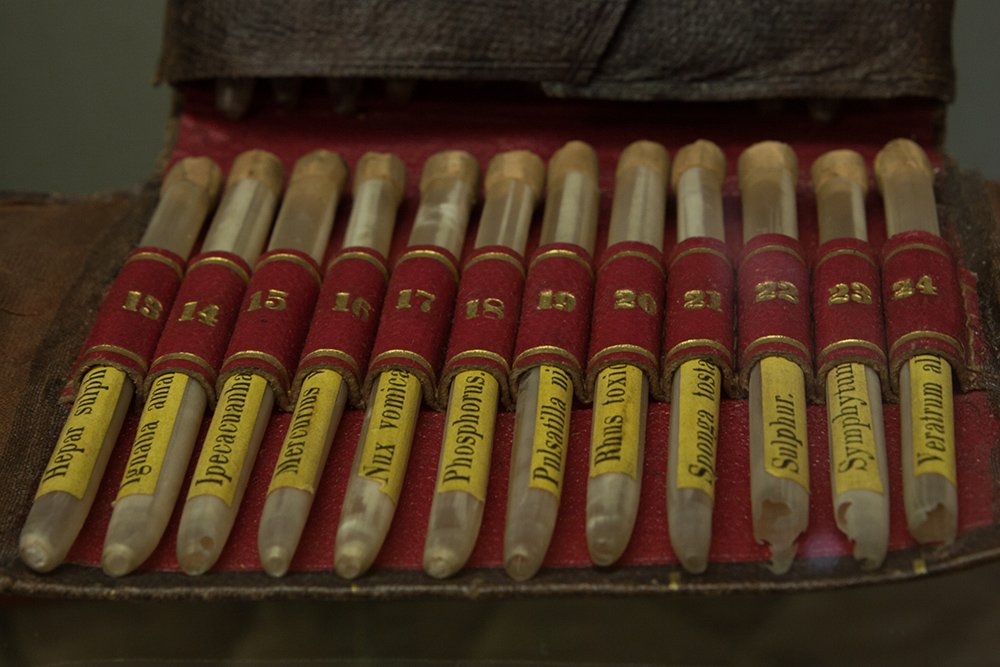
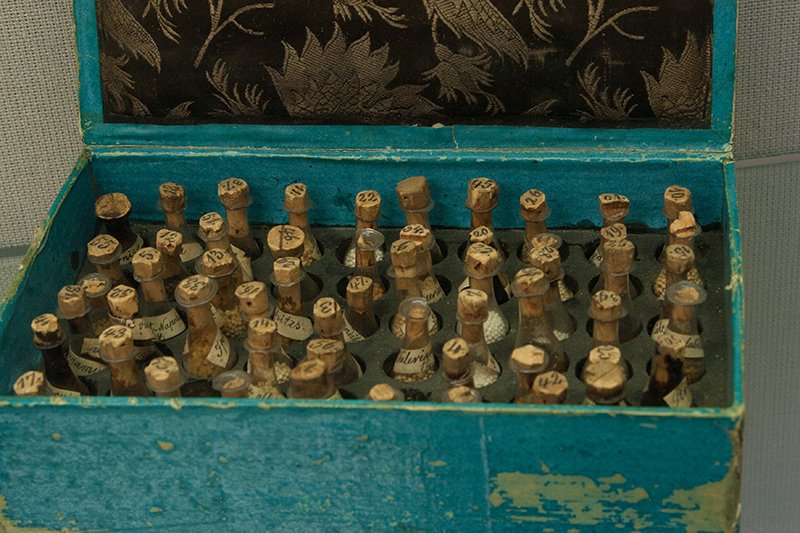
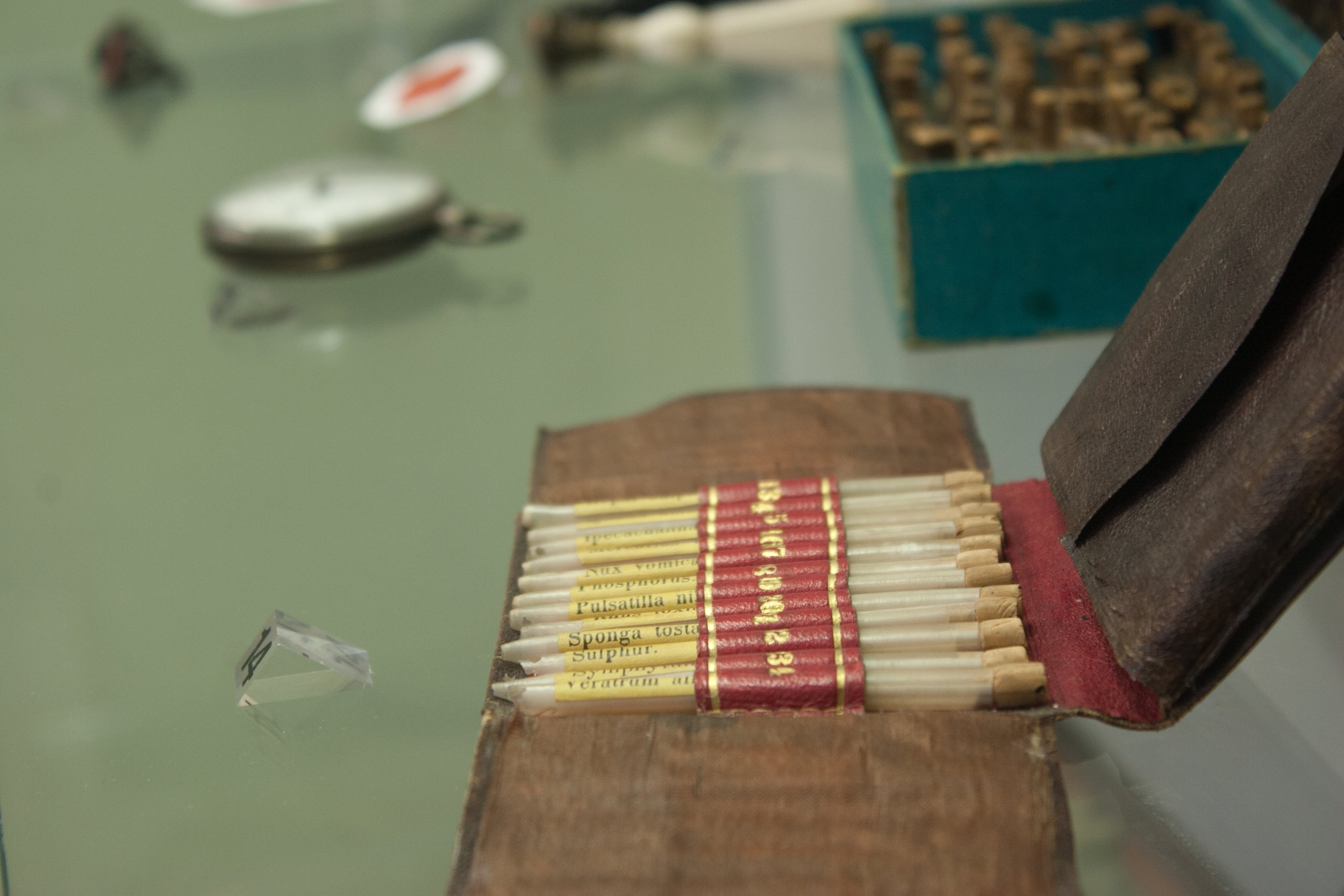
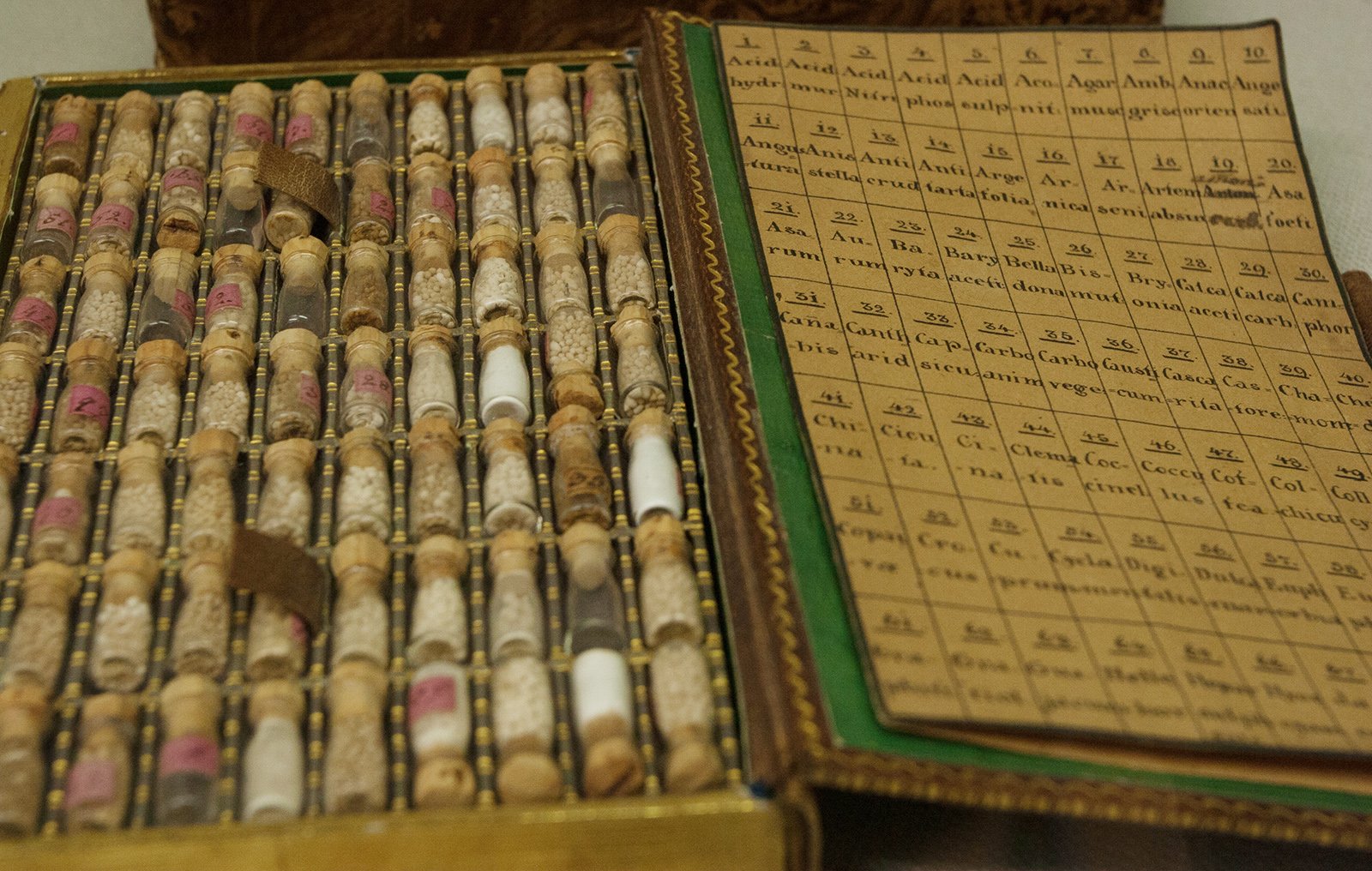
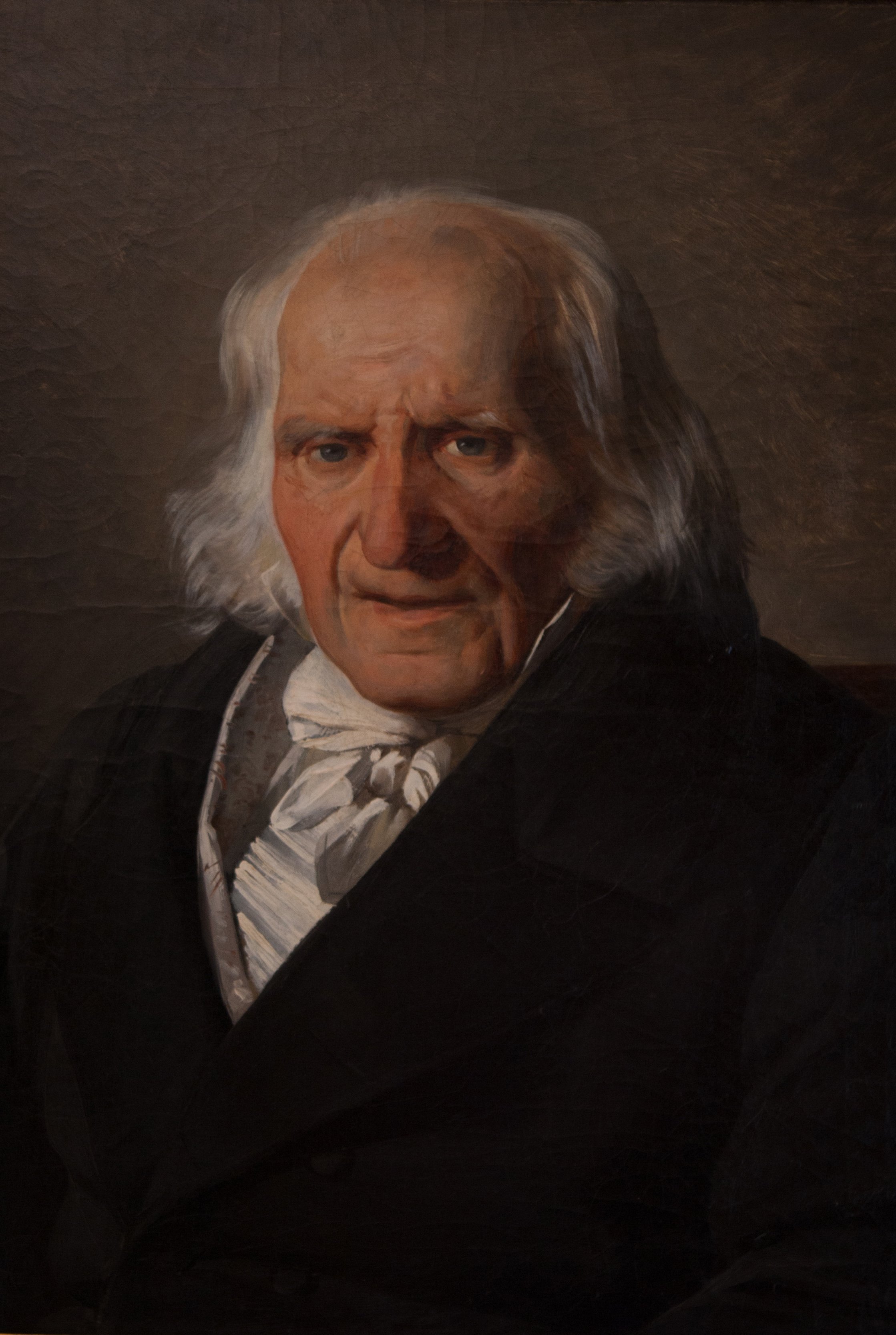
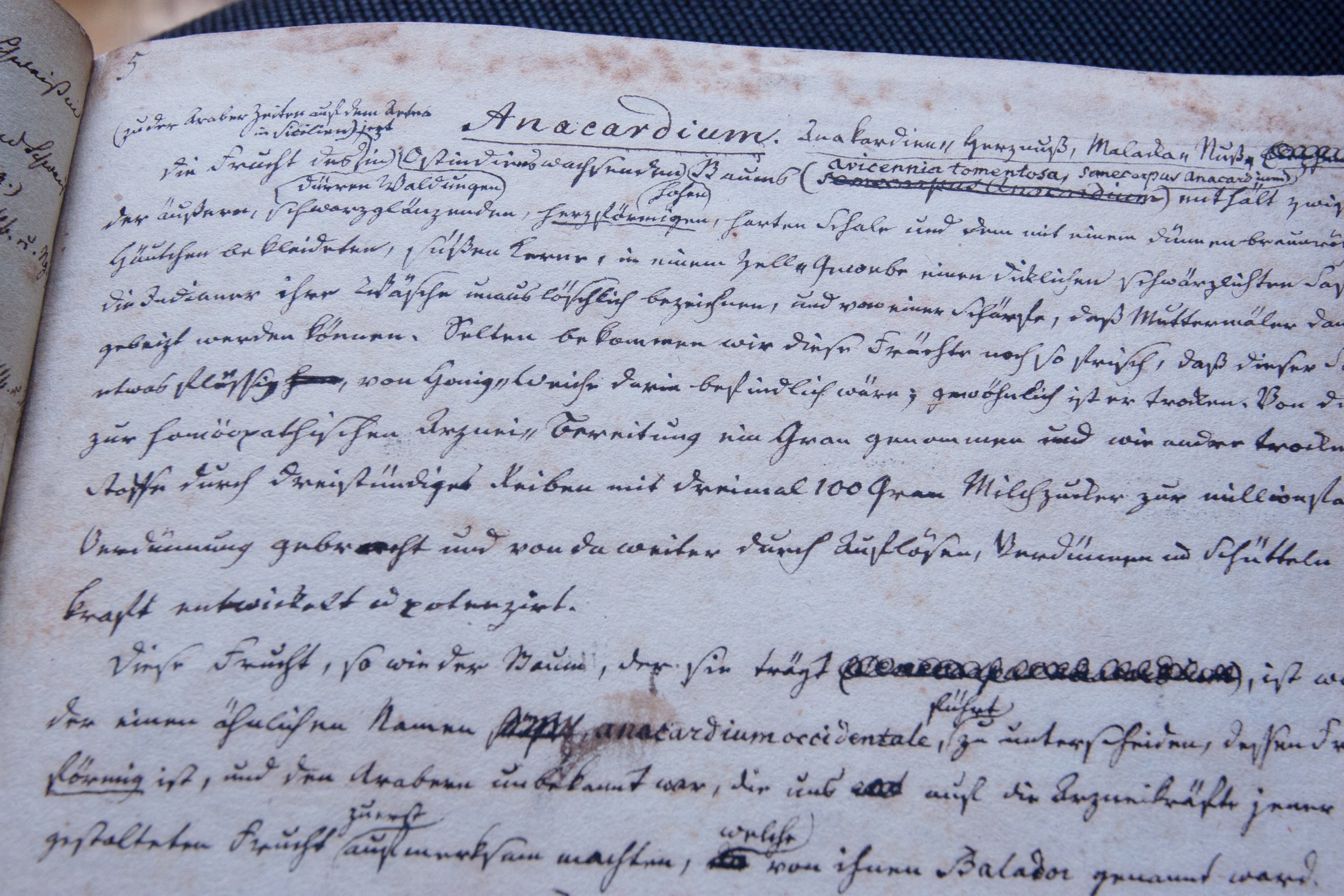
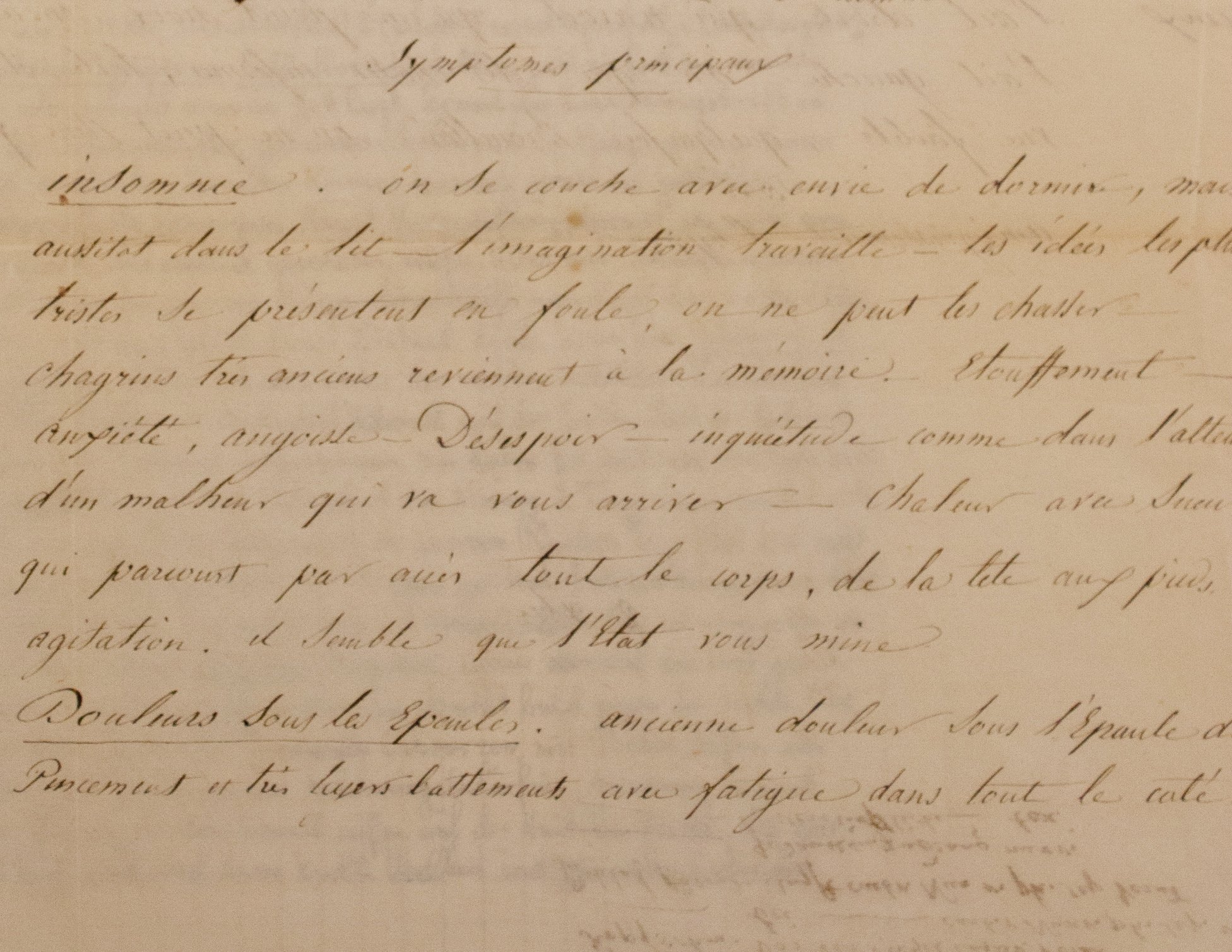
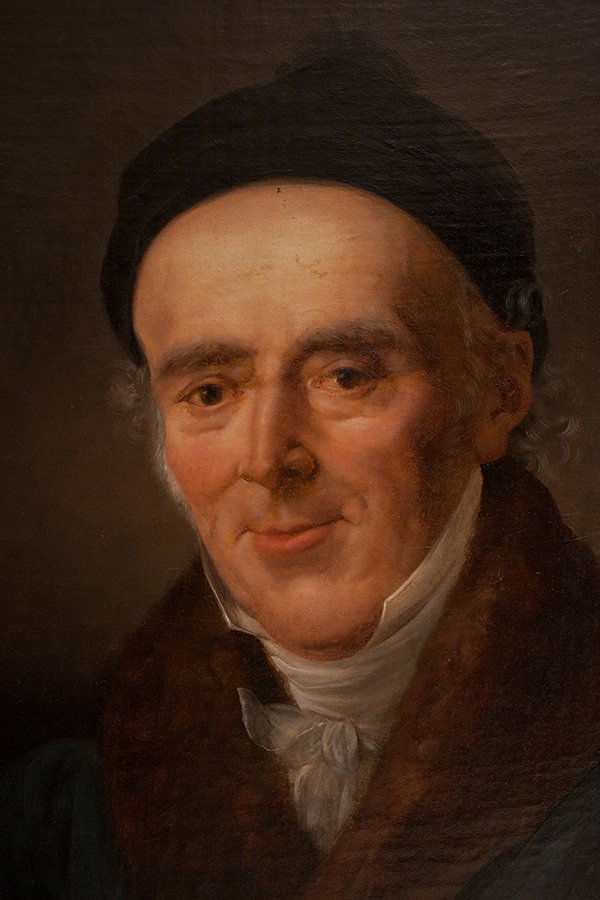
Top left to right: Hahnemann original travel kit (in a quill!); Hahnemann original homeopathic remedies for dispensing
Bottom left to right: Portrait of Bonnenhausen, friend to Hahnemann; original writings Hahnemann on Anacardium; original casetaking by Melanie Hahnemann in French (from the Paris practice); portrait Hahnemann as painted by Melanie.
It can be said that the Asterales flowers function as a co-operative. The flowers are among the plant kingdoms most advanced botanical structures, and being at the end of the column represents our most developed state to date and seems to parallel our time.